Egyptian Talisman
Showing all 24 results
-

Blue Eye Leather Bracelet
-

Blue Eye Necklace
-

Evil eye protection jewelry amulet
-

Eye of Horus pendant amulet
-

Magic Egyptian Amulet
-

Magic lucky charm amulet
-

Magic Protection Pendant Necklace
-

Men’s Talisman Necklace
-

Protection Amulet
-

Protection Amulet
-

Protection eye necklace
-

Protection pendant amulet
-

Protection pendant amulet
-

Protection pendant necklace
-

Protection talisman amulet
-

Protection Talisman Necklace
-

Protection talisman necklace
-

Protective Eye Amulet Pendant
-

Protective Talisman Necklace
-

Silver Evil Eye Necklace
-

Spiritual protection amulet
-

Talisman jewelry amulet
-

Talisman necklace
-

Talisman pendant necklace
Understanding the Egyptian Talisman: Beyond a Simple Historical Piece of Jewelry
An Egyptian talisman is not just a decorative object. It is a condensed form of ancient beliefs, a ritual tool whose design and symbolism were conceived for a precise function. The Egyptians of the Old Kingdom, around 2700 BC, formalized the use of these amulets, convinced of their ability to influence destiny, protect against illness, or ensure a peaceful passage into the afterlife. Their significance extends far beyond aesthetics, rooted in the spiritual and the practical.
Origins and Functions of Ancient Egyptian Amulets
Talismans, or amulets, accompanied the Egyptians at every stage of life, from birth to death. Their primary function was protection. For example, the Djed pillar offered stability and resurrection, often placed in tombs for the deceased. Specific amulets shaped like frogs were believed to bring fertility, while others, in the form of a heart scarab, were meant to prevent a negative judgment of the soul after death, as evidenced by numerous examples found in the royal sarcophagi of the New Kingdom, dating from 1550 to 1070 BC.
Distinguishing an Authentic Replica from a Simple Commercial Imitation
In today’s market, the distinction between a faithful replica and a mere trinket is crucial. A meaningful replica is based on solid archaeological research, respecting proportions (a period Wadjet eye rarely measured more than 5 cm), materials (blue-green Egyptian faience was predominant), and engraving techniques. A low-end imitation will settle for a generic mold in resin or non-compliant metal. Expertise lies in the ability to identify these details, which transform an object into a true echo of ancient Egypt.
The Key Symbols of Egyptian Talismans and Their Associated Powers
Every shape, every motif engraved on an Egyptian amulet held a codified meaning. These symbols were not arbitrary; they embodied divine forces, virtues, or specific forms of protection. Knowing their history is essential to choosing a talisman that truly resonates with a personal intention.
The Sacred Scarab: Symbol of Rebirth and Solar Protection
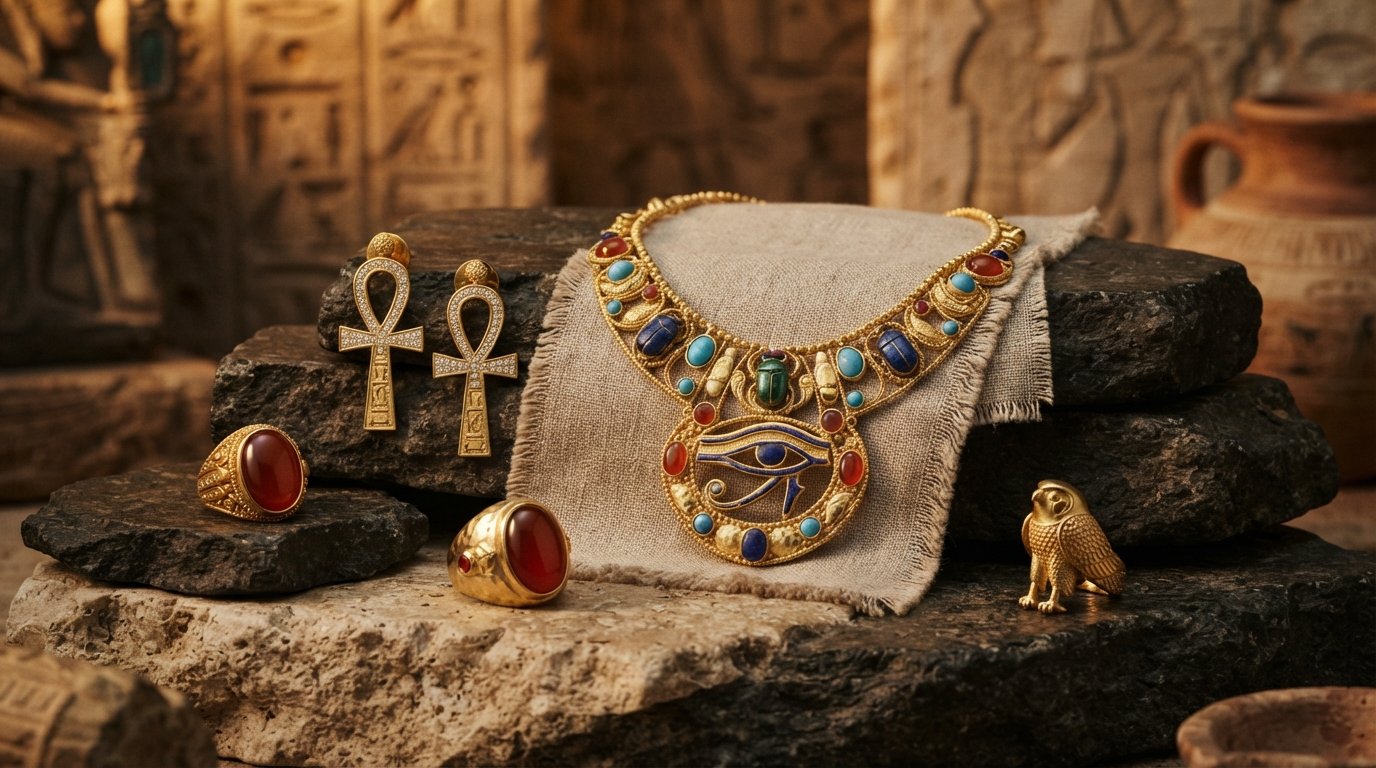
The scarab, inspired by the dung beetle, was one of the most widespread amulets. It symbolized the god Khepri, the rising sun, representing rebirth, transformation, and vital force. Scarabs were commonly carved from glazed steatite, sometimes lapis lazuli, and measured between 1 and 10 cm. Those found in the tomb of Tutankhamun (around 1323 BC) demonstrate their importance in life and the afterlife, serving as seals, jewelry, and protection all at once.
The Wadjet Eye (Eye of Horus): Vision, Health, and Divine Strength
The Wadjet Eye, or Eye of Horus, is a powerful symbol of protection, healing, and physical wholeness. It evokes the myth of Horus, whose torn-out eye was restored by Thoth. This eye was believed to ward off evil, protect its wearer from illness and envy, and restore balance. Frequently made of faience or carnelian, it was a common personal talisman, often worn around the neck or wrist, ensuring constant vigilance.
The Ankh and the Djed Pillar: Eternal Life and Cosmic Stability
The Ankh, the “looped cross,” is the symbol of eternal life, vitality, and immortality. Often held by the gods in wall frescoes, it represents the key to life. The Djed pillar, meanwhile, embodies the stability, permanence, and strength of Osiris, the god of the dead and rebirth. These two symbols were often paired together, signifying a stable and solid eternal life. They can be found engraved on everyday objects as well as on sarcophagi, from the New Kingdom onward.
Choosing Your Egyptian Talisman: Essential Quality Criteria
Acquiring an Egyptian talisman, whether a historical replica or a contemporary interpretation, requires understanding what makes it a worthwhile piece. Material quality and fidelity to the original symbolism are non-negotiable points for a connoisseur.
Ancient and Modern Materials: Faience, Metal, and Fine Stones
Historically, amulets were made from Egyptian faience (a composite material based on silica fired at around 800-950°C), glazed steatite, lapis lazuli, carnelian, or, for the elite, pure gold (24 carats) and silver. Today, faithful replicas favor 925 sterling silver, bronze, or natural stones like onyx or turquoise. Avoid synthetic materials or cheap metals that convey none of the material qualities of the originals. A good talisman uses materials that will age gracefully.
The Importance of Historical Context: When the Symbol Tells a Story
A talisman gains extra depth when its wearer understands its context. Exploring the period of origin (Old, Middle, New Kingdom), the associated myth, and the guardian gods (Isis for protection, Thoth for knowledge) enriches the experience. For instance, a heart scarab may be more relevant for someone seeking to align their intentions, while a Wadjet eye is ideal for everyday protection. It’s not just about aesthetics; it’s a connection to a millennia-old story.
Care and Personal Meaning of Your Egyptian Amulet
Owning an Egyptian talisman means preserving it and integrating it with intention into your life. The physical object is a medium; its true value lies in the meaning you give it.
How to Preserve Your Talisman’s Lifespan Every Day
Care depends on the material. For silver, gentle cleaning with a specialized polishing cloth once a month is enough to maintain its shine. Avoid contact with harsh chemicals (perfumes, chlorine). For natural stones or faience, simple cleaning with lukewarm soapy water and immediate drying with a soft cloth is recommended. Store each talisman in an individual pouch to prevent scratches and impact damage.
Beyond the Object: The Personal Resonance of the Symbol
A talisman is not a magical relic acting on its own. Its power comes from the intention and connection its wearer establishes with it. It can serve as a tangible reminder of a quality you wish to cultivate (the scarab’s perseverance, the Eye of Horus’s clairvoyance) or a protection you seek. It is not the object that grants power, but the way you use it as an anchor for your own personal journey.
What is the difference between a scarab and an Eye of Horus for everyday protection?
The scarab offers general protection focused on transformation, rebirth, and perseverance in the face of challenges. It is ideal for those going through change or seeking to strengthen their resilience. The Eye of Horus, on the other hand, offers more specific protection against evil, illness, and injustice, acting as a watchful guardian and restorer of physical and spiritual wholeness.
How do I choose my first Egyptian talisman if I’m new to the subject?
Start by focusing on the meaning that resonates most with your personal aspirations. If you’re seeking vitality, opt for an Ankh. If it’s clairvoyance, a Wadjet eye is fitting. For a first purchase, choose a replica in 925 silver or bronze for their durability, within an indicative price range of 50 to 150 euros for a piece of artisanal quality.
Which materials are the most durable for a talisman I would wear often?
Sterling 925 silver is an excellent choice for its sturdiness and the patina it develops over time. Hard stones such as lapis lazuli, carnelian, or jasper, set on metal, are also highly resistant to daily wear. Egyptian faience, while historically authentic, is more fragile and should be worn with greater care to avoid chipping.
How do I properly care for my talisman so it keeps its shine?
For a silver talisman, use a soft polishing cloth once or twice a month and avoid contact with chlorinated products or harsh cosmetics. For stone or faience pieces, occasional cleaning with lukewarm water and mild soap is sufficient. Always be sure to dry it immediately afterward and store it in an individual pouch away from impacts.