Egyptian Signet Rings
Showing 1–36 of 50 results
-

Ancient Egyptian Men’s Ring
-

Ancient Egyptian ring
-

Ancient Egyptian ring
-

Ankh cross jewelry ring
-

Ankh cross ring
-

Ankh cross ring
-

Ankh ring
-

Antique Egyptian Ring
-

Anubis ring
-

Black cat ring
-

Egypt ring
-

Egyptian Cross Ring
-

Egyptian eye of Horus ring
-

Egyptian eye ring
-

Egyptian men’s ring
-

Egyptian Protective Ring
-

Egyptian scarab ring
-

Egyptian Signet Ring
-

Egyptian Silver Ring
-

Eye of Horus ring
-

Eye of Horus ring
-

Magic protection ring
-

Magic ring
-

Men’s Egyptian Eye of Horus hieroglyph ring
-

Men’s Egyptian Signet Ring
-

Men’s Eye of Horus Ring
-

Men’s Scorpion Ring
-

Men’s Snake Ring
-

Original Egypt Ring
-

Pharaoh Ring
-

Pharaoh signet ring
-

Pharaohs ring
-

Protection ring
-

Protective ring
-

Pyramid Ring
-

Pyramid shape ring
Egyptian signet rings: a legacy of power and symbols
The signet ring, in its Egyptian form, is not a simple band. It is a condensed piece of history, a functional and symbolic object whose significance dates back more than 4,000 years. Far from purely aesthetic contemporary creations, these rings carried within them the authority of a seal, the protection of an amulet, and the status of their owner. Today, choosing a signet ring inspired by ancient Egypt means adopting a piece that tells the story of a civilization, its gods, its kings, and its worldview.
Function and status in ancient Egypt
As early as the Old Kingdom (around 2700-2200 BC), the Egyptians used rings as seals to authenticate documents and property. These cylinder seals, and later flat scarabs, inlaid or mounted on rings, were essential for scribes, dignitaries, and the pharaoh himself. The ring was not a mere accessory: it was a tool of legal validation and a distinctive social mark. A solid gold ring with a royal cartouche or a divine symbol identified a member of the ruling elite, while faience or bronze rings could be more widespread.
Materials and techniques of pharaonic jewelers
Egyptian craftsmen mastered goldsmithing with remarkable precision. They worked gold (often mined in Nubia), silver, bronze, as well as semi-precious materials such as lapis lazuli, carnelian, turquoise, and quartz. Egyptian faience, a blend of silica and pigments fired at high temperature, made it possible to produce brightly colored objects, often blue or green, for less costly rings. Granulation, cloisonné, and engraving techniques were common, allowing small elements of stone or glass to be set into the bezel of the signet ring, ensuring remarkable durability for the era.
Iconography and meaning: decoding the key motifs
Every symbol engraved on an Egyptian signet ring carried a precise meaning, often linked to protection, rebirth, or authority. These motifs were not chosen at random; they invoked divine forces, recalled founding myths, or asserted the identity of the wearer. Understanding these symbols means grasping the cultural depth of these jewels.
The sacred scarab: more than a simple ornament
The scarab, or Khepri, is undoubtedly the most iconic motif of Egyptian signet rings. Associated with the rising sun god, Ra, it symbolizes rebirth, transformation, and protection against evil. The underside of the scarab was often engraved with hieroglyphs, deities, or royal names, serving as a seal. A glazed steatite scarab, for example, was a popular amulet for everyday life as well as the afterlife, worn on a finger to ward off negative influences and ensure a favorable life cycle.
Ankh, Eye of Horus, and other protective symbols
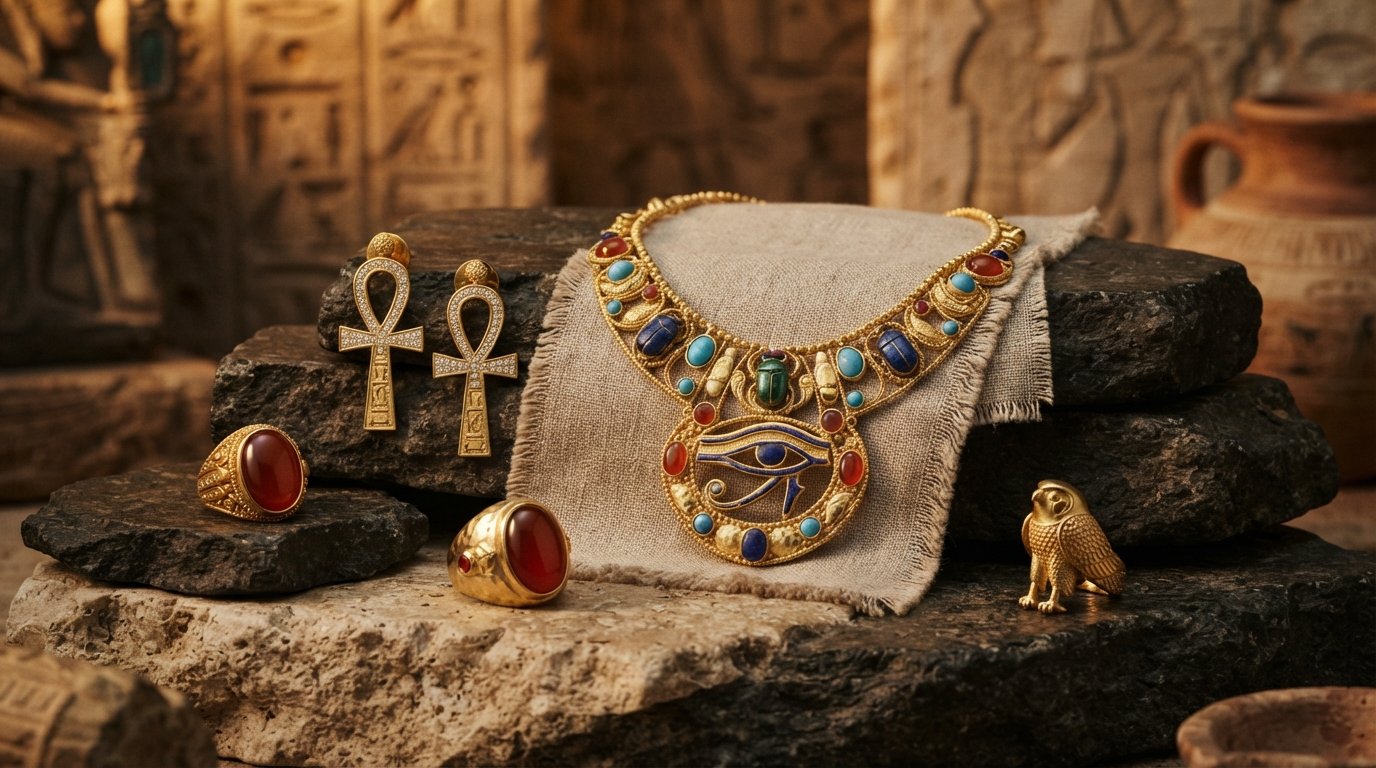
The Ankh, or cross of life, is a hieroglyph meaning “life” or “breath of eternal life.” Set into a signet ring, it granted its wearer longevity and the protection of the gods. The Eye of Horus, or Wedjat Eye, symbolizes protection, good health, and restoration. It was believed to heal illness and ward off curses. Other motifs, such as the Uraeus cobra (a symbol of sovereignty and royal protection) or the Djed pillar (a symbol of stability and endurance), were also common, each reinforcing the protective power or status of the jewel.
Divine and royal representations
Figures of gods such as Isis, protector and universal mother, or Horus, protector of the pharaoh, appear frequently. Mythological scenes or effigies of famous pharaohs, such as Ramesses II or Tutankhamun, also featured on the bezels. These representations directly linked the wearer to divine powers and royal authority, turning the signet ring into a personal mini-pantheon and a badge of recognition. A signet ring depicting the goddess Sekhmet might be worn to invoke her protection in times of war or illness.
Choosing your Egyptian signet ring today: between history and modernity
Acquiring an Egyptian-inspired signet ring today means distinguishing between museum pieces, faithful reproductions, and modern creations that borrow ancient codes. The quality of the materials and the fidelity to the original motifs are decisive criteria for an informed purchase that pays tribute to this age-old heritage.
The importance of contemporary materials: 925 silver, 18-carat gold
For a modern Egyptian signet ring, the materials used determine both durability and aesthetics. Sterling 925 silver is a popular choice, offering good resistance and a shine appreciated across various budgets. For a more significant piece, 18-carat gold (75% pure gold) guarantees a deep color and intrinsic value, evoking pharaonic treasures. Engravings on fine stones such as onyx or carnelian, set into the bezel, enhance visual authenticity while providing better resistance to everyday scratches.
Design authenticity or modernized inspiration
The market offers a variety of designs. Some signet rings are near-perfect replicas of archaeological models, sometimes made using casting or engraving techniques faithful to the originals. Other pieces draw on Egyptian motifs (scarabs, hieroglyphs), adapting them to a more contemporary style with clean lines or new stone inlays. It is essential to check the origin of the design: is it inspired by a dated artifact, for example a New Kingdom ring displayed at the Louvre, or is it a freer interpretation? This distinction guides the choice toward a piece steeped in history or a jewel with a timeless style.
Size and comfort for everyday wear
A signet ring must be worn comfortably. Ring size is crucial: a signet ring that is too loose risks slipping off, while one that is too tight can restrict circulation. The weight of the metal also plays a role; a solid gold ring, for example, will weigh more than a hollow silver piece. The bezel, the engraved top part, must be proportioned to the size of the finger so as not to hinder movement. It is often recommended to try several sizes and bezel shapes, especially for models with pronounced relief, to ensure a perfect fit for prolonged daily wear.
How do you choose the ideal size for an Egyptian signet ring?
The size of an Egyptian signet ring is key to comfort. Measure your finger accurately, ideally at the end of the day when your fingers are slightly swollen. For a wide bezel or a thick design, consider going half a size above your usual measurement. Don’t hesitate to try on a ring of similar width to confirm the fit.
What is the difference between an Egyptian-inspired signet ring and a historical reproduction?
A historical reproduction aims to faithfully recreate an existing artifact, respecting its proportions, motifs, and sometimes even its manufacturing techniques. An inspired signet ring, on the other hand, takes up Egyptian symbols (scarab, Ankh) but incorporates them into a more modern design, with different lines or new material combinations. Reproductions appeal to archaeology enthusiasts, while inspired pieces appeal to those seeking a current style with a touch of history.
Which materials are the most durable for an Egyptian-motif signet ring?
18-carat gold and sterling 925 silver are sturdy choices. Gold, thanks to its density and resistance to corrosion, ensures maximum durability and minimal upkeep. 925 silver is also resistant but can tarnish over time, requiring regular cleaning. For bezels, engravings on hard stones such as onyx, carnelian, or lapis lazuli are more resistant to impact than motifs engraved directly into the metal.
How do you care for a silver signet ring with Egyptian motifs?
A 925 silver signet ring requires simple but regular care. Clean it with a soft cloth designed for silver or a gentle cleaning solution, such as warm soapy water, gently rubbing the engravings. Rinse and dry thoroughly to avoid streaks. Avoid prolonged contact with harsh chemicals (perfumes, chlorine) and store it in an individual pouch to limit oxidation and scratches.