Egyptian Pectorals
Showing all 23 results
-

Blue Stone Necklace
-

Choker
-

Choker necklace
-

Choker necklace
-

Choker necklace
-

Egyptian Collar Necklace
-

Egyptian style Collar Necklace
-

Egyptian women’s necklace
-

Gold choker necklace
-

Gold choker necklace
-

Gold-tone Collar Necklace
-

Original choker
-

Original Collar Necklace
-

Silver choker
-

Silver choker necklace
-

Silver Color Collar Necklace
-

Steel Collar Necklace
-

White choker necklace
-

Women’s choker necklace
-

Women’s choker necklace
-

Women’s Collar Necklace
-

Women’s Collar Necklace
-

Women’s steel Collar Necklace
The Egyptian Pectoral: A Masterpiece of Ancient Jewelry
Origins and function of pharaonic pectorals
Egyptian pectorals emerged as significant elements of adornment as early as the Middle Kingdom, between 2055 and 1650 BC. Their role went beyond mere aesthetics: they served as powerful amulets, embodying divine protection and royal authority. Worn by pharaohs, dignitaries and priests during rituals, these ornaments also accompanied the deceased in their tombs, ensuring their integrity for the journey into the afterlife. A pectoral could sometimes incorporate several hundred grams of gold and stones, underscoring its sacred and material importance.
The emblematic materials of Egyptian pectorals
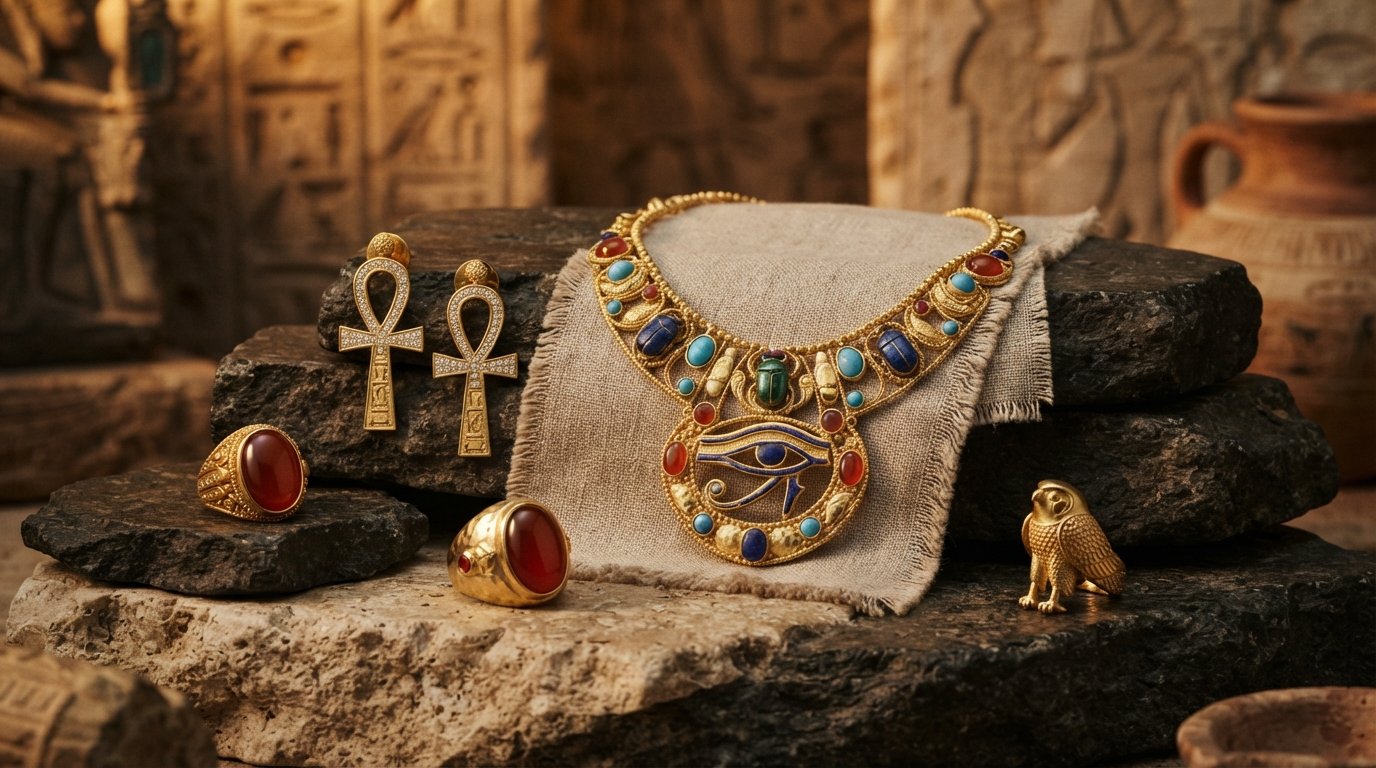
The value of pectorals lay in the meticulous choice of their components. Gold, a symbol of eternity and the flesh of the gods, formed the metal base. It was commonly enhanced with inlays of lapis lazuli, evoking the night sky and the divine, turquoise for fertility, and carnelian for solar energy and vitality. Egyptian faience, or _qad_, a glazed ceramic in intense blue and green hues, offered a striking alternative, more accessible yet just as meaningful. The choice of each stone and colour was deliberate, adding layers of significance to the jewel.
Complex symbolism and messages of royal pectorals
Every motif on a pectoral is a visual statement. The scarab, for instance, symbolises rebirth and the solar cycle. The vulture goddess Nekhbet and the cobra uraeus protected the pharaoh, while the Eye of Horus (Wedjat) bestowed health and prosperity. These iconographic compositions, often symmetrical, formed a refined visual language, understood by the elite and reinforcing the bond between the ruler and the cosmos. Tutankhamun’s pectoral, unearthed in 1922, features a scarab carved from lapis lazuli, illustrating the mastery of ancient goldsmithing.
Timeline and Evolution of Pectoral Styles
From Old Kingdom pectorals to Late Period designs
While the earliest pectoral jewellery dates back to the Old Kingdom (c. 2686-2181 BC) in the form of simplified amulets, it was during the Middle Kingdom (c. 2055-1650 BC) that the pectoral took on its characteristic look. Pieces such as the pectorals of Senusret II and Amenemhat III, held at the Egyptian Museum in Cairo, reflect this period with their detailed mythological scenes and precise inlays. The Late Period (c. 664-332 BC) saw the emergence of more stylised designs, sometimes incorporating foreign influences, while still maintaining the fundamental iconographic codes.
Technical and aesthetic innovations of the New Kingdom
The New Kingdom (c. 1550-1070 BC) represents the pinnacle of Egyptian goldsmithing. Cloisonné and inlay techniques reached a peak of virtuosity. Pectorals from this era, particularly those from Tutankhamun’s treasure, display intricate figurative scenes, royal cartouches and meticulously crafted hieroglyphs. The colour palette expanded, incorporating coloured glass alongside semi-precious gems. A pectoral depicting the god Ra and the sacred scarab could contain hundreds of individually inlaid pieces.
Regional variations and foreign influences on pectorals
Ancient Egypt was in constant interaction with neighbouring cultures. Exchanges with Nubia, the Levant and Crete sometimes left subtle marks on pectoral design. Although the iconographic repertoire remained deeply Egyptian, certain shapes or colour combinations could betray outside influences. However, the pectoral’s visual identity always prevailed, making it instantly recognisable. The Ptolemaic period (332-30 BC) illustrates a fusion with Hellenistic elements, while preserving the essence of Egyptian design.
Choosing an Egyptian Pectoral: Criteria for the Discerning Collector
Authentication and reproduction: identifying historical value
An authentic pectoral from ancient Egypt is a museum-grade rarity, often of priceless value. For collectors, the market offers replicas and inspired creations. A superior-quality reproduction draws on rigorous archaeological research, faithfully replicating dimensions, for example a 10 cm x 12 cm format for a typical funerary pectoral, and materials such as gilded brass or glazed faience. The manufacturing method is a key indicator: a piece crafted with hand-set inlays will hold greater value than a simple stamped item.
Condition and restoration: impact on valuation
For an antique piece, condition is decisive. Loss of inlays, metal oxidation or cracks reduce its value. For a replica, attention to finishing is essential. A surface intentionally aged to simulate antiquity must be done with discernment. A well-executed restoration on an artefact can stabilise its value, but a clumsy intervention can compromise it. Beware of excessive artificial patinas that may conceal imperfections.
Iconography and decoration: understanding the most sought-after motifs
The appeal of a pectoral often lies in its iconography. Motifs depicting the god Ra, the winged scarab, Horus the Child on a lotus, or the protective goddesses Isis and Nephthys are particularly sought after for their strong symbolism. A pectoral featuring a stylised Eye of Horus can be a fitting choice for its meaning of protection. Learning about the significance of these motifs enriches your appreciation of the piece and helps guide your choice toward an item that resonates with your personal preferences.
Care and Preservation of Ancient Egyptian-Inspired Jewellery
Tips for preserving pectoral replicas
To preserve the shine of your pectoral, avoid direct and prolonged exposure to sunlight, which could alter the tones of resins or faience. It is best to store it in a dry environment, away from humidity and dust. A fabric-lined box or a display case are ideal solutions. Always handle the piece by its edges to avoid marking the surface and transferring natural skin oils.
Cleaning specific materials: faience, stones, metals
Cleaning should be tailored to the materials. A faience or resin pectoral should be gently wiped with a soft, dry cloth, occasionally slightly dampened with clean water for surface grime. Absolutely avoid harsh chemical products, which could damage the enamel or pigments. For metal parts (brass, bronze, copper), a non-abrasive jewellery polishing cloth is recommended, for example once a year, to maintain shine without risk of scratching. Stone inlays require even more delicate handling.
How can you tell an authentic Egyptian pectoral from a quality replica?
An authentic pectoral is an archaeological piece subject to strict regulations, showing the marks of time, wear and a natural, thousand-year-old patina. Quality replicas stand out through the fidelity of their design to the original artefacts and the use of durable materials such as brass or glazed faience. They are not presented as originals, but aim for a precise and respectful aesthetic recreation.
What are the most common materials used in making Egyptian pectorals, and what are their care requirements?
Ancient pectorals were made of gold, lapis lazuli, turquoise, carnelian and faience. Modern replicas often use gilded alloys (brass, bronze), coloured resins or faience. For care, gilded metals should be cleaned with a soft, non-abrasive cloth, while faience and resins need regular dusting and can be wiped with a slightly damp cloth, without harsh chemical products.
Is an Egyptian pectoral suitable for all occasions, or is it better suited to collecting?
Egyptian pectorals are imposing, symbolic pieces, with some models reaching 20 cm in width. While more discreet replicas can be worn for themed events or as a bold accessory, most large pectorals are better suited to collecting or display. They then become true objects of art and conversation, ideal for enriching an interior space.
How important is the iconography of an Egyptian pectoral when making your choice?
Iconography is at the heart of the message conveyed by a pectoral. Choosing a motif that matches your interests, such as the scarab for rebirth, the Eye of Horus for protection, or deities like Isis for motherhood, will deepen your connection with the piece. Every symbol held a precise meaning in ancient Egypt, and understanding these nuances adds considerable depth to your acquisition.