Egyptian Necklaces
Showing 37–72 of 100 results
-

Egyptian magic necklace
-

Egyptian necklace
-

Egyptian necklace for men
-

Egyptian pendant necklace
-

Egyptian Pendant Necklace
-

Egyptian pharaoh necklace
-

Egyptian Scarab Necklace
-

Egyptian scarab Necklace
-

Egyptian scarab necklace
-

Egyptian scarab necklace jewelry
-

Egyptian scarab pendant necklace
-

Egyptian Style Eye Necklace
-

Egyptian Style Necklace
-

Evil eye necklace
-

Evil eye necklace
-

Eye Necklace
-

Eye of Horus Necklace
-

Eye of Horus Necklace
-

Eye of Horus necklace
-

Eye of Horus necklace
-

Eye of Horus pendant necklace
-

Eye of Horus pendant necklace
-

Goddess Isis Pendant Necklace
-

Gold eye necklace
-

Gold pharaoh pendant necklace
-

Gold Snake Necklace for Men
-

Horus pendant necklace
-

Isis Goddess Egyptian pendant necklace
-

Magic Protection Pendant Necklace
-

Men’s Ankh Cross Necklace Jewelry
-

Men’s Ankh Cross Pendant Necklace
-

Men’s Ankh Necklace
-

Men’s Egypt Necklace
-

Men’s Egyptian Cross Necklace
-

Men’s Egyptian Necklace
-

Men’s Egyptian necklace
The Legacy of Ancient Egyptian Necklaces: More Than an Ornament
Egyptian necklaces are not mere ornaments; they represent a tangible piece of the history and spirituality of a civilization thousands of years old. From the Old Kingdom (around 2700-2200 BC), these adornments held both a strong aesthetic and symbolic function, worn by pharaohs, priests, and the elite. Each piece told a story of power, protection, or divine affiliation, often meant to accompany the deceased into the afterlife.
Deep Symbolism and Ceremonial Materials
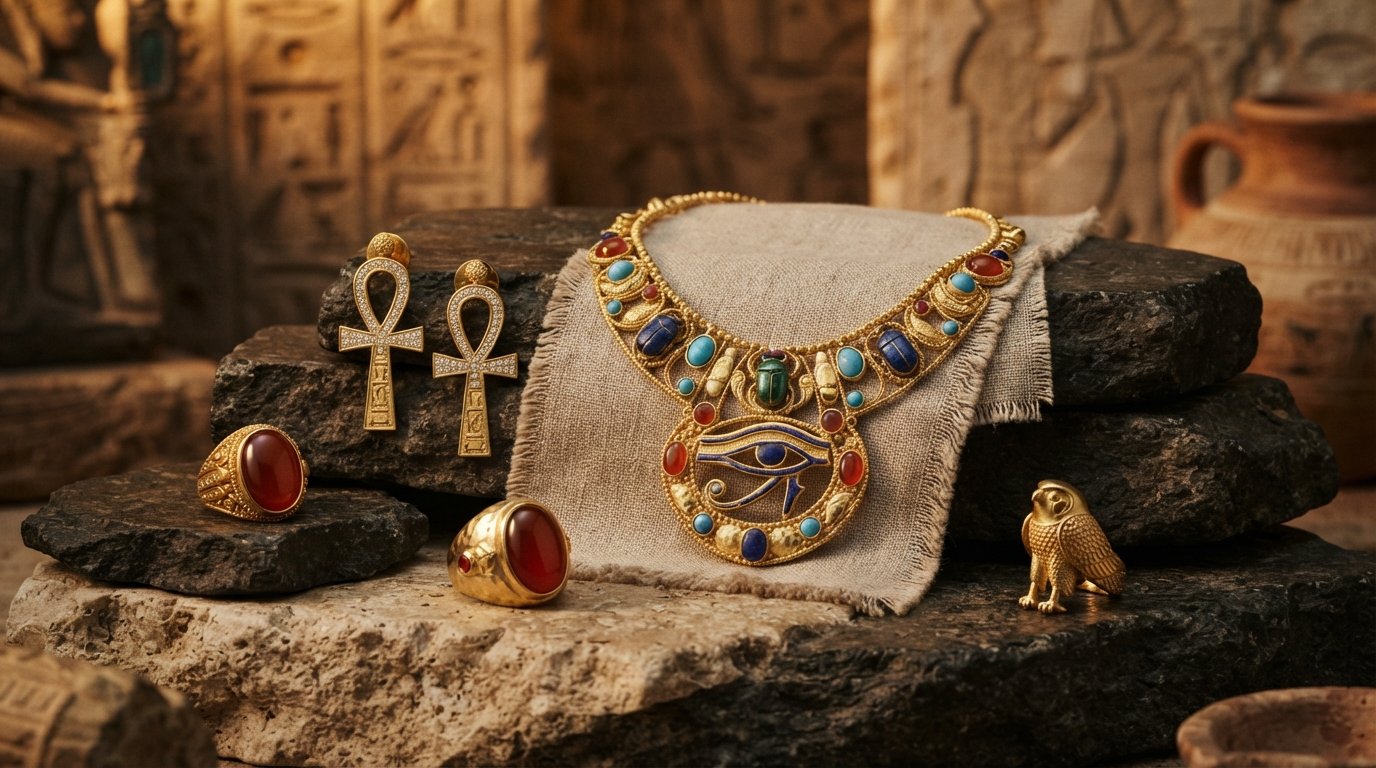
The iconography of Egyptian necklaces is rich: the scarab symbolized rebirth and protection against the forces of evil, while the Wedjat eye (or Eye of Horus) offered health and prosperity. The Ankh cross represented eternal life. These motifs were not chosen at random but incorporated into adornments made of tubular beads, discs, or pendants. The materials themselves carried meaning: lapis lazuli, imported from Afghanistan as early as 3000 BC, evoked the night sky and the gods; carnelian recalled blood and vitality; Egyptian faience, with its blue and green hues, was associated with fertility and the Nile.
Craftsmanship Techniques and the Evolution of Pharaonic Styles
Egyptian jewelry making developed advanced techniques for its time. The use of granulation to create textured surfaces, the inlaying of stones and glass paste, or repoussé work on gold sheets, all attest to remarkable technical mastery. The ousekh collar, wide and multi-strand, is an iconic example, covering the shoulders and chest, often balanced by a counterweight (the menat) at the back, which also served as a protective amulet and tintinnabulum. These pieces were not merely jewelry but attributes of status and ritual objects.
Inspiring Icons and Historical References
Figures such as Cleopatra, although from the Ptolemaic period, and above all Tutankhamun, with the treasure discovered in 1922 by Howard Carter, embody the splendor of Egyptian necklaces. The young pharaoh’s pectoral, adorned with a lapis lazuli scarab and solar and lunar symbols, is a striking example of a piece rich in meaning and exceptional technical execution. These discoveries continue to influence contemporary design, proving the lasting appeal of Egyptian aesthetics.
Modern Egyptian Necklaces: Reinterpretations and Everyday Wearability
The fascination with ancient Egypt transcends the ages. Today, necklaces inspired by this civilization are no longer confined to museums. Designers reinterpret Egyptian motifs and codes, adapting them for everyday wear and making this heritage accessible without diluting its meaning. These are not copies, but reinterpretations that bridge history and current trends, offering unique, meaningful pieces.
Classic Motifs Reinvented for Everyday Wear
The scarab, the Ankh, the Eye of Horus, or the head of Nefertiti now appear on pendants made of solid silver or gold-plated metal, sometimes streamlined for a contemporary touch. These motifs, once laden with complex rituals, are now chosen for their timeless aesthetic and the symbolic power they still carry. A necklace with a small silver scarab can be worn as a discreet good-luck charm, while a miniaturized replica of a pharaonic bronze pendant can add a touch of originality to an outfit.
A Fusion of Materials: Metal, Stone, and Contemporary Faience
While gold and lapis lazuli remain the materials of choice for high-end pieces, modern designers explore a broader palette. Sterling silver, patinated bronze, or stainless steel make these designs more affordable and durable. Ceramic or glass beads, and even colored resins, can mimic the look of ancient faience or semi-precious stones like turquoise or agate, while offering the lightness and range of colors suited to current tastes. This blending of materials opens the door to bold creations that honor the spirit of the originals without strictly following tradition.
Choosing Your Egyptian Necklace: A Guide for the Informed Enthusiast
Acquiring a necklace inspired by ancient Egypt requires some understanding of the available options. Between historical reproductions, inspired pieces, and more contemporary creations, your choice should align with your expectations for quality, style, and meaning. An expert would advise favoring genuine materials over superfluous details, and design coherence over an accumulation of symbols.
Identifying Authenticity and Material Quality
For an Egyptian necklace, the quality of the materials is essential. Check the purity of the silver (often 925 sterling) or the gold plating (at least 3 microns over brass or silver). If the piece includes stones, make sure they are clearly identified (genuine lapis lazuli, carnelian, turquoise) and not simple plastic imitations. Well-executed settings or precise inlay work are signs of careful craftsmanship and a guarantee of durability. Ask yourself: will this piece stand the test of time, like the originals it imitates or draws inspiration from?
Matching Style to Occasion and Personality
An Egyptian necklace can be a real statement piece. For everyday wear, opt for a discreet pendant, such as a small silver Ankh or a stylized scarab, which will pair well with various outfits. For a special occasion, a bolder necklace, reminiscent of grand pectorals or breastplate-style collars, can become the focal point of an outfit. Also consider chain length: a choker will highlight the neck, while a longer necklace with a larger motif will draw the eye to the chest area. Your choice should reflect your personality and the story you want to tell.
How do I choose an Egyptian necklace that suits my personal style?
Decide whether you prefer a detailed historical replica or a streamlined modern interpretation. Discreet motifs like a minimalist Eye of Horus work well for everyday wear, while an elaborate breastplate is ideal for special events. Consider the metal color (silver, gold, bronze) and how well it matches your everyday wardrobe.
What is the specific meaning of a scarab or Ankh motif on a necklace?
The scarab symbolizes regeneration, protection, and the cycle of the rising sun, bringing luck and new life. The Ankh, or cross of life, represents eternal life and is often associated with fertility and immortality. Both symbols were widespread in Egyptian culture for their protective powers.
How do I properly care for an ancient Egyptian-inspired necklace with semi-precious stones?
Clean it gently with a soft, dry cloth to avoid scratching the stones. Avoid direct exposure to chemicals, perfumes, and seawater, which can damage the metal and stones. Store your necklace away from moisture and direct light, ideally in an individual pouch to prevent knocks and scratches.
Is an Egyptian necklace also suitable for a man?
Absolutely. Many Egyptian motifs, such as the Ankh, the Eye of Horus, or pendants inspired by pharaonic cartouches, are worn by men. Opt for masculine designs, often bolder or with more geometric lines, in silver or patinated bronze. A dog tag-style necklace featuring an Egyptian symbol is a discreet, contemporary option.