Egyptian Bracelets
Showing 37–72 of 99 results
-

Egyptian scarab jewelry bracelet
-

Egyptian snake bracelet
-

Egyptian Stone Bracelet
-

Egyptian White Pearl Bracelet
-

Egyptian Women’s Arm Cuff
-

Evil Eye Bracelet
-

Eye of Horus Bangle Bracelet
-

Eye of Horus bracelet
-

Eye of Horus Bracelet
-

Gold Snake Bracelet
-

Happiness Bracelet
-

Happiness Bracelet
-

Horus Bracelet
-

Luck Bracelet
-

Lucky Charm Bracelet
-

Men’s Arm Bracelet
-

Men’s Black Bracelet
-

Men’s Cross Bracelet
-

Men’s Egyptian Bead Bracelet
-

Men’s Egyptian Bracelet
-

Men’s Egyptian Leather Bracelet
-

Men’s Egyptian Silver Bracelet
-

Men’s Egyptian Stone Bracelet
-

Men’s eye of Horus chain bracelet
-

Men’s leather Horus bracelet
-

Men’s lucky charm bracelet
-

Men’s Lucky Charm Bracelet
-

Men’s Silver Snake Bracelet
-

Men’s snake bracelet
-

Men’s Snake Bracelet
-

Men’s snake jewelry bracelet
-

Nefertiti bracelet
-

Nefertiti Egyptian Bracelet
-

Pharaoh Bracelet
-

Pharaoh leather bracelet
-

Red lucky charm bracelet
The Millennia-Old Heritage of Egyptian Bracelets and Their Relevance Today
Egyptian bracelets embody centuries of history, deep-rooted beliefs and a distinctive art form that has endured across millennia. From the Old Kingdom (circa 2700-2200 BC) through to the Roman period, these jewelry pieces served as both protective amulets and markers of social status or religious affiliation. Each piece, whether found on the wrist of a pharaoh or an ordinary citizen, told a story of life, death and the afterlife. Far from mere clichés, archaeological study of tombs, such as that of Tutankhamun discovered in 1922 by Howard Carter, reveals a complexity and intention behind every ornament, well beyond simple aesthetics.
Protection and Symbolism: The Essence of Ancient Egyptian Jewelry
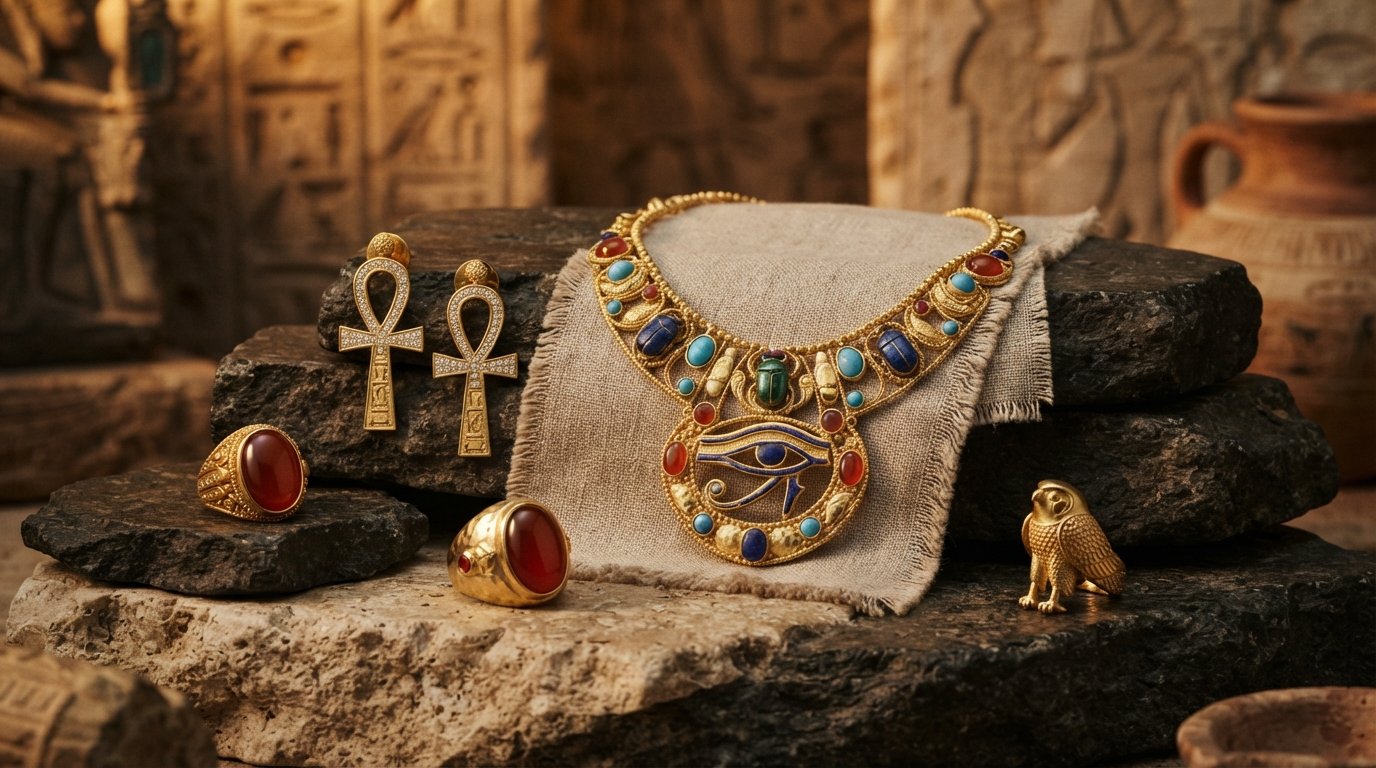
In ancient Egypt, a bracelet was never neutral. It was imbued with power, meant to protect its wearer from evil forces or bring them fortune and fertility. Concrete examples abound: the scarab bracelet, for instance, symbolized the cycle of the sun, regeneration and rebirth. It was not merely a carved insect, but a representation of the god Khepri pushing the sun across the sky each morning. Likewise, the Eye of Horus, or Wedjat, offered protection against evil and ensured health and prosperity, its precise motif often engraved with rigorous geometric detail. These elements, far from being incidental, were essential components of daily and spiritual life.
Materials and Techniques: The Precise Craftsmanship of Egyptian Goldsmiths
The expertise of Egyptian craftsmen showed in their choice of materials and technical mastery. Gold, lapis lazuli, turquoise, carnelian and amethyst were commonly used, often set or inlaid with remarkable precision. Bracelets were shaped through hammering, casting (the lost-wax method) or granulation. Goldsmiths of the New Kingdom period (circa 1550-1070 BC) mastered the cloisonné technique, inlaying semi-precious stones into gold or silver compartments to create vibrant patterns. The Cairo Museum displays several pieces from this era, testifying to this skill. A solid gold bracelet could weigh between 50 and 150 grams, clearly marking its owner as a person of high rank.
The Standout Motifs of Egyptian Bracelets and Their Meanings
The motifs on Egyptian bracelets are not random; each carries a specific and powerful message. Understanding these symbols allows you to choose a piece that truly resonates with a personal intention. Beyond their intrinsic beauty, these motifs serve as keys to understanding one of the most complex civilizations in history.
The Sacred Scarab: Symbol of Rebirth and Solar Protection
The scarab, or sacred dung beetle, is one of Egypt’s most recognizable symbols. Associated with the god Khepri, it embodies the rising sun and the cycle of rebirth. Bracelets adorned with scarabs were worn to ensure protection, vitality and fertility. Archaeologists have discovered scarab seals dating from the Middle Kingdom (circa 2055-1650 BC) that served as talismans or personal identifiers. A scarab engraved on the underside of a bracelet, often with a hieroglyphic inscription, was not just decoration; it was a carrier of positive energy and a shield against evil.
The Eye of Horus and the Ankh: Clairvoyance and Eternal Life
The Eye of Horus, the Wedjat, represents divine protection, health and knowledge. It is often reproduced with mathematical precision, with each part of the eye said to represent a mathematical fraction (1/2, 1/4, 1/8, etc.) of the senses. As for the Ankh, the “key of life,” it is the symbol of eternal life and regeneration. Both motifs are omnipresent in Egyptian iconography and on bracelets, offering their wearers not only a connection to the divine but also an affirmation of their pursuit of vitality and immortality. A bracelet featuring the Ankh, for example, is not just an accessory, but a constant reminder of life force.
Egyptian Cuff Bracelets: Imperial Elegance for the Wrist
Cuff bracelets were particularly prized by pharaohs and the upper classes. Often wide and elaborately worked, they covered a significant portion of the forearm. Made of solid gold or gilded bronze and inlaid with precious stones, they were not designed to be discreet. Consider the pieces found on royal mummies, for example, which could reach 5 to 8 cm in width. Today, Egyptian-inspired cuff bracelets carry forward this stylistic boldness, offering a strong presence on the wrist. They are often chosen to assert a style with a distinct historical character, whether an aged silver piece or a more contemporary polished brass design.
Choosing and Caring for Your Egyptian-Inspired Bracelet
Acquiring a bracelet inspired by ancient Egypt calls for careful thought. Beyond aesthetics, it’s about understanding what each symbol represents and choosing a piece that matches your values. Caring for these jewelry pieces, often made of metals and stones that react differently to their environment, is also crucial to preserving their shine and integrity over the long term.
How to Select an Egyptian Bracelet: Materials and Meanings
When choosing, first consider the meaning of the symbol. Do you prefer the protection and regeneration of the scarab, the clairvoyance of the Eye of Horus, or the vitality of the Ankh? Next, the material is essential. A 925 silver bracelet, for instance, will be more affordable and develop a distinctive patina over time, while a brass or bronze piece will offer a more rustic and historical aesthetic. For inlays, imitation lapis lazuli or turquoise are common, but a genuine stone will have a unique depth of color and texture. Check the quality of the stone setting, as authentic historical Egyptian jewelry favored durability.
Care Tips to Preserve the Beauty of Your Egyptian Jewelry
Care depends on the material. For silver, a soft cloth soaked in a specific silver cleaning solution is effective for removing tarnish. Brass or bronze pieces can be polished with a suitable product to bring out their original shine. Avoid prolonged contact with salt water, harsh chemicals like bleach, and perfumes, which can dull metals and damage stones. Store your bracelets separately to prevent scratches, ideally in a fabric pouch. Regular cleaning with lukewarm soapy water (mild soap) and a soft-bristled brush, followed by thorough drying, is often enough to maintain the shine of non-porous stones.
How do you choose the right size for an Egyptian cuff bracelet?
For a cuff bracelet, measure the circumference of your wrist at its widest point, just above the wrist bone. A cuff bracelet should fit snugly enough not to slip, yet remain comfortable enough not to pinch. Most designs feature a slight opening, allowing a gentle adjustment of about 1 to 2 centimeters for optimal comfort.
What is the difference between an ancient Egyptian bracelet and a modern reproduction?
An ancient Egyptian bracelet is an archaeological artifact, often subject to strict conservation and trade regulations. A modern reproduction draws on these historical designs using present-day materials. The difference lies in age, provenance certified by archaeological expertise, and historical value versus contemporary aesthetic and craftsmanship value.
Who is an Egyptian bracelet featuring an Ankh or an Eye of Horus best suited for?
A bracelet featuring an Ankh is ideal for someone looking to symbolize life, vitality or a fresh start. One with the Eye of Horus suits people seeking protection, mental clarity or physical well-being. Although these symbols are ancient, they retain a universal resonance for those who appreciate their deep meaning.
Can you wear an Egyptian bracelet every day?
Yes, many Egyptian-inspired bracelets are designed for daily wear. Check the material: silver or stainless steel are durable choices. Bracelets with delicate stones or intricate inlays may require more care to avoid impacts or excessive exposure to moisture. Regular maintenance will extend the life of your jewelry.
How do you care for a lapis lazuli Egyptian bracelet?
Lapis lazuli is a relatively soft stone. Clean it gently with a soft, dry cloth. If needed, use a little lukewarm water with a very mild soap, then rinse quickly and dry immediately. Avoid harsh chemicals and prolonged exposure to direct sunlight or water, which can dull its color or damage its surface.