Egyptian Amulets
Showing 1–54 of 107 results
-

Ancient Egypt amulet
-

Ancient Egypt necklace amulet
-

Ancient Egyptian Amulet
-

Ancient Horus Amulet
-

Ankh Amulet
-

Ankh Amulet
-

Ankh Cross Amulet
-

Ankh Cross Amulet
-

Ankh Cross Amulet
-

Ankh cross Amulet necklace
-

Ankh Cross Jewelry Amulet
-

Ankh Cross Jewelry Amulet
-

Ankh cross jewelry amulet
-

Ankh Cross Men’s Amulet
-

Ankh cross necklace amulet
-

Ankh cross of life amulet
-

Ankh cross of life jewelry amulet
-

Ankh cross of life pendant amulet
-

Ankh Cross Symbol Amulet
-

Ankh cross symbol amulet
-

Ankh Jewelry Amulet
-

Ankh key amulet
-

Ankh necklace amulet
-

Ankh pendant amulet
-

Ankh Symbol Amulet
-

Antique cartouche amulet
-

Anubis pendant amulet
-

Authentic Egyptian Amulet
-

Blue scarab pendant amulet
-

Egypt Amulet
-

Egypt pharaoh amulet
-

Egyptian Amulet
-

Egyptian Ankh Amulet
-

Egyptian ankh cross amulet
-

Egyptian Ankh Cross Amulet
-

Egyptian Ankh Life Amulet
-

Egyptian Ankh Life Cross Amulet
-

Egyptian cartouche amulet
-

Egyptian Cartouche Amulet Pendant
-

Egyptian cat amulet
-

Egyptian Cat Pendant Amulet
-

Egyptian cross amulet
-

Egyptian cross Amulet amulet
-

Egyptian cross pendant amulet
-

Egyptian cross sign amulet
-

Egyptian cross silver pendant amulet
-

Egyptian Eye Amulet
-

Egyptian key amulet
-

Egyptian Life Cross Amulet
-

Egyptian life cross pendant amulet
-

Egyptian Life Symbol Amulet
-

Egyptian medal amulet
-

Egyptian medallion amulet
-

Egyptian Men’s Cross Pendant Amulet
Egyptian Amulets: Function and Power in Ancient Egypt
Far from being simple ornaments, Egyptian amulets are objects charged with a precise function and profound symbolic power. For millennia, they served as essential tools for personal protection, the perpetuation of life, and the transition into the afterlife. Used from the Old Kingdom, around 2700 BC, through to the Roman period, these small carved or engraved forms embodied divine principles, deities, or aspects of the Egyptian cosmos. Understanding an amulet means deciphering part of the thinking and beliefs of a civilization that held an immense devotion to the survival of the soul and to cosmic order.
A millennia-old legacy: the impact of amulets in daily life and funerary rites
Amulets were present across every layer of Egyptian society. They were worn by the living to ward off evil, promote fertility, or ensure good health. Their role took on capital importance in the funerary context: placed on the mummy or in the tomb, they granted the deceased ongoing protection and access to the benefits of the afterlife. Their shapes and materials were chosen with intention, with every detail contributing to their magical effectiveness — a fundamental principle for the Egyptians.
Decoding the Symbols: The Most Common Egyptian Amulets
The pantheon of Egyptian amulets is vast, but certain symbols stand out for their recurrence and the strength of their message. Knowing their meaning is the first step to appreciating these objects beyond their aesthetics alone. Each shape offers a direct reading of the concerns and hopes of the Egyptians from over 3,000 years ago.
The sacred scarab: symbol of rebirth and vital protection
The scarab, or Khepri, is arguably the most iconic amulet. Inspired by the dung beetle rolling its ball of dung, it symbolized for the Egyptians the god of the rising sun, bringer of regeneration and new life. Heart scarabs, often inscribed with Spell 30B from the Book of the Dead, were placed on the heart of the deceased to prevent it from testifying against them during divine judgment. Their dating spans from the Middle Kingdom to the Ptolemaic period, with variations in style and materials.
The Wadjet Eye and the Ankh: icons of healing and eternal life
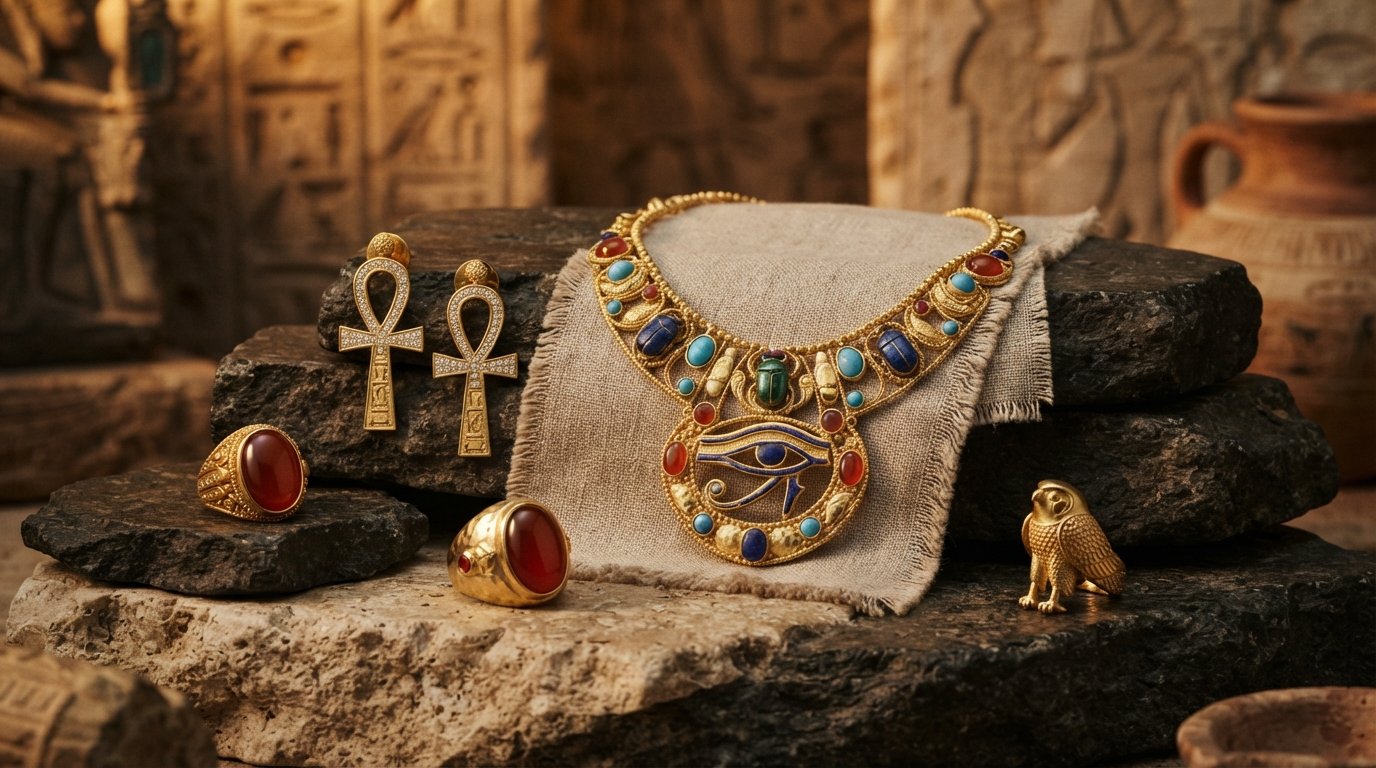
The Wadjet Eye, or Eye of Horus, represents healing, protection, and the restoration of physical and spiritual wholeness. According to mythology, Horus recovered his eye, torn out by Seth, thanks to Thoth, and gave it to his father Osiris. This is why it became a powerful talisman. The Ankh, the looped cross, is the hieroglyph for “life” and one of the most recognizable Egyptian symbols. Held by numerous deities, it embodies the breath of life, immortality, and eternal life itself. Ankh amulets were often given as a wish for a long life.
The Djed Pillar and the Knot of Isis: pillars of stability and feminine power
The Djed Pillar is a symbol of stability, endurance, and the backbone of Osiris, representing resurrection. It was often raised during ceremonies to ensure the permanence of pharaonic rule and the strength of the ordered world. The Knot of Isis, or Tyet, is an amulet with protective properties, often associated with fertility and the maternal power of the goddess Isis. Made from red carnelian, it was believed to grant the protection of Isis, particularly on the journey through the afterlife.
Materials and Craftsmen: The Art of Egyptian Amulets
The value of an amulet lay not only in its symbol but also in the materials used and the skill of its maker. Ancient Egypt developed unique techniques to produce these objects, making them both durable and aesthetically meaningful.
Egyptian faience: a technical signature and a color palette
Egyptian faience is not faience in the modern sense, but a paste of crushed quartz, often mixed with clay and coated with a vitreous alkaline glaze that gave it its characteristic sheen. Mass-produced from the 12th Dynasty onward, this material allowed for vivid colors, such as the blue-green associated with the Nile, fertility, and rebirth. Its hardness after firing made it ideal for durable amulets, often depicting gods or sacred animals.
Gold and semi-precious stones: materials with heightened powers
Gold was considered the flesh of the gods, an eternal and incorruptible material reserved for pharaohs and the highest dignitaries. Gold amulets, or those inlaid with stones such as lapis lazuli (symbolizing the sky and divinity), carnelian (for blood and life), or amethyst (for royalty), were objects of great luxury and power. They were often commissioned for specific rituals or to accompany royal burials, such as those found in the tomb of Tutankhamun.
Acquiring an Egyptian Amulet: Tips for Collectors
For Egyptology enthusiasts or collectors, acquiring an Egyptian amulet is a pursuit that combines historical passion with discernment. Whether seeking an ancient piece or a faithful reproduction, a few criteria can help make the right choice.
Authenticity and traceability of antique amulets
The question of authenticity is essential for any amulet presented as antique. A genuine piece is ideally accompanied by documentation proving its provenance and history. Authentic pieces, when still available on the legal market, often come from old collections or documented official excavations. Without clear traceability, choosing a museum-quality reproduction is a responsible option that is just as rewarding for study and appreciation.
Choosing an amulet: between personal symbolism and historical aesthetics
The choice of an amulet can be guided by its symbolism. While the Wadjet Eye is renowned for protection, a scarab may be preferred for its connection to rebirth. Also consider the materials: a reproduction in Egyptian faience will better capture the historical look than a piece made of modern resin. Size and level of detail are also indicators of quality. A well-crafted amulet, even a reproduction, will offer a richer immersion into Egyptian aesthetics.
How can you tell an authentic Egyptian amulet from a modern copy?
The authenticity of an antique amulet relies on several clues. Patina, the natural wear of materials, and manufacturing techniques (such as specific Egyptian faience) are important markers. Ideally, an authentic piece should come with a certificate of authenticity or documentation proving its provenance and history within an established collection. Without this traceability, it is difficult to guarantee an object’s origin.
Which Egyptian amulet should you choose for everyday personal protection?
For personal protection, the Wadjet Eye (Eye of Horus) is a classic choice, known for warding off evil and promoting healing. The scarab also offers protection while symbolizing regeneration. The choice will depend on the meaning you want to prioritize and your affinity with the symbol. Consider the material: an amulet made of natural stone or reproduced faience will hold up better than a piece made of lightweight metal.
Are there specific amulets for prosperity or success?
For prosperity and success, the scarab is once again relevant, symbolizing regeneration and the solar cycle, and thus a constant renewal of opportunities. The Ankh, as a symbol of life and vitality, can also be interpreted as a good-luck charm for a rich and fulfilling life. Other amulets, such as the tilapia fish, were associated with fertility and abundance at mealtimes, which can extend to the concept of prosperity.
How do you care for an antique Egyptian amulet or a quality reproduction?
Amulets, whether antique or faithful reproductions, require gentle care. For faience pieces, simply dusting with a soft, dry brush is enough. Avoid chemical products or immersion in water, which could damage the glaze or patina. Metal pieces (bronze, silver) can be cleaned with specific non-abrasive products, while semi-precious stones only need a soft, damp cloth. The key is to handle these objects with care, given their potential fragility.