Cleopatra Egyptian Jewelry
Showing all 7 results
-

Alexandria Round Egyptian Earrings
-

Cleopatra Bracelet
-

Cleopatra earrings
-

Cleopatra Egyptian Earrings
-

Cleopatra women’s bracelet
-

Egyptian necklace
-

Women’s Egyptian earrings
The Legacy of Cleopatra’s Jewelry: Between Myth and Egyptian History
Jewelry inspired by Cleopatra VII Philopator (69-30 BC) is far more than simple adornment. It embodies an era when Egyptian jewelry-making reached its peak, shaped by millennia-old pharaonic traditions and the Hellenistic influences of the Ptolemaic dynasty. Its significance goes beyond aesthetics, touching on the history of power and symbolism. Understanding these pieces means immersing yourself in the world of a strategist queen who used imagery to establish her authority.
Cleopatra VII and Her Influence on Jewelry
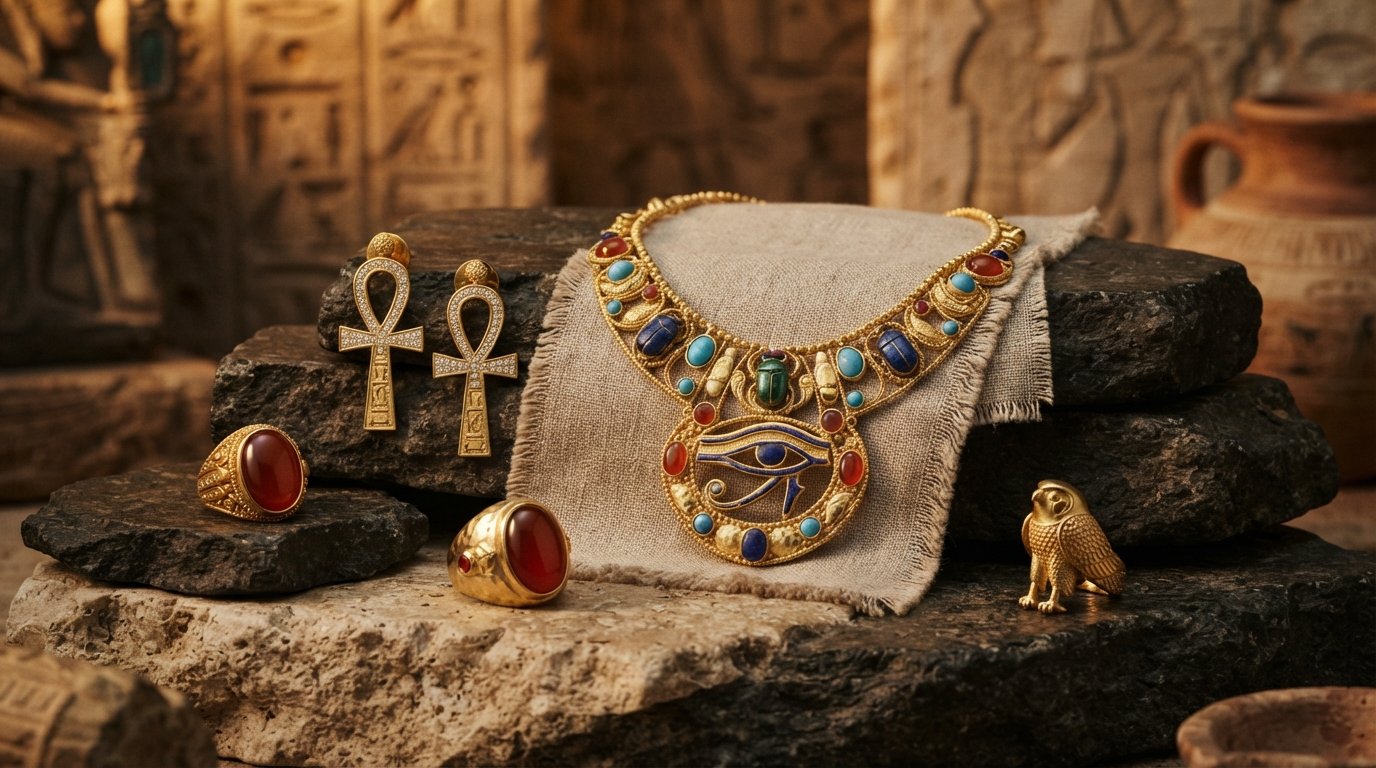
Cleopatra, the last queen of Egypt, mastered the art of representation like no other. Her adornments were never chosen at random; they conveyed messages of divinity, royalty, and fertility. She is known to have favored gold, a material associated with the sun god Ra and immortality, often worked with remarkable finesse. Dangling earrings, intricate choker necklaces, and diadems adorned with cobras (uraeus) were markers of her status. An Usekh collar, for example, could weigh several hundred grams of solid gold, incorporating strands of lapis lazuli, carnelian, and turquoise beads—gemstones already prized during the New Kingdom (1550-1070 BC).
The Precious Materials of Ancient Egypt
Gold, mined in Nubia, was the pharaohs’ metal of choice. It was used to craft pieces of remarkable durability. Alongside pure gold (24 karat), electrum alloys (gold and silver) were also used for their varied shine. As for gemstones, lapis lazuli, imported from Afghanistan, symbolized the night sky and the divine universe. Turquoise, mined in the Sinai as early as 3000 BC, represented regeneration. Red carnelian, sourced locally, was associated with vitality and blood. Together, these three stones formed the fundamental color triad of ancient Egyptian jewelry, creating a striking visual contrast against the brilliance of gold.
Symbolism and Motifs of Pharaonic Jewelry
Beyond their material value, Egyptian jewels were talismans imbued with profound meaning. Every motif was a silent hieroglyph, a prayer, or a form of protection. Wearing Egyptian jewelry today means embracing a piece of this ancient iconography, directly connected to the beliefs and cosmogony of the pharaonic era.
The Scarab and the Ankh: Protective Egyptian Amulets
The scarab, or heart scarab, is undoubtedly one of the most recognizable motifs. A symbol of resurrection and rebirth, it was often engraved on rings or pendants to protect the wearer in this life and the afterlife. Scarab amulets dating back to the Middle Kingdom (2055-1650 BC) are common. The Ankh, the “key of life,” represents eternal life. Often worn as a pendant or incorporated into larger designs, it served as a constant reminder of the desire for immortality and divine protection. Excavations have uncovered gold Ankhs measuring 5 to 10 cm, sometimes inlaid with lapis lazuli, worn by dignitaries.
The Eye of Horus and Serpents: Power and Regeneration
The Eye of Horus, or Wadjet Eye, is a powerful symbol of protection, healing, and insight. Pharaohs and ordinary people alike wore it to ward off the evil eye. It is commonly found on gold or silver pendants, stylized with precise detailing. The serpent, particularly the rearing cobra (uraeus), was the emblem of the pharaohs, symbolizing their sovereignty and their power over life and death in Egypt. Cleopatra herself is often depicted with a cobra on her diadem, a powerful sign of her royal legitimacy. Jewelry featuring a coiled serpent motif, sometimes adorned with small stones, pays direct homage to this iconography.
The Colors of Gemstones in Ancient Egyptian Jewelry
The choice of colors was never arbitrary. The blue of lapis lazuli evoked the sky, the Nile, and divinity. The green of turquoise symbolized fertility, life, and resurrection, echoing the lush fields that followed the Nile’s flooding. The red of carnelian represented energy, the sun, and vital blood. Combined, these colors created pieces that were both visually striking and rich in meaning. It is common to find ancient jewelry where these three shades dominate, often set in yellow gold for maximum contrast and visual impact.
Choosing Egyptian Jewelry: Authenticity and Contemporary Design
Acquiring jewelry inspired by ancient Egypt or Cleopatra raises the question of balancing historical respect with modern relevance. An expert can tell a quality piece apart, whether it’s a faithful replica or a modern interpretation. It’s essential to prioritize durable materials and craftsmanship that honors the techniques of the era, even when using today’s tools. Metals such as 18-karat gold or 925 silver, paired with natural stones like lapis lazuli, turquoise, or carnelian, are a guarantee of value and longevity.
How to Recognize a Faithful Reproduction of Egyptian Jewelry
To verify the authenticity of a reproduction, examine the precision of the motifs: an Eye of Horus should have exact proportions, and a scarab should feature the characteristic engravings of its legs and head rather than a simple oval shape. Patina can be a telling indicator; quality replicas may feature a finish that mimics centuries of natural wear without compromising the jewelry’s structure. Favor artisans who detail their sources of inspiration, often drawn from museum collections such as the Louvre or the British Museum, for a more well-documented reproduction.
Pairing Cleopatra Jewelry with Modern Style
Contrary to what you might expect, Cleopatra-inspired jewelry can blend seamlessly into a contemporary wardrobe. A minimalist gold Ankh pendant can complement an understated outfit, while a cuff bracelet adorned with a cobra motif can become the standout piece of an evening ensemble. The key is not to overdo it: a single statement piece is often enough to create the desired visual impact. A collar necklace like the Usekh calls for an open neckline, while a subtle scarab ring can be worn every day.
What is the most iconic piece of Egyptian jewelry to choose for a first purchase?
For a first purchase, we recommend a scarab ring or pendant. This motif is universally recognized as a symbol of protection and rebirth, and it’s easy to wear every day. A 925 silver piece with a lapis lazuli inlay offers an excellent balance between authenticity and price.
What’s the difference between pharaonic-era Egyptian jewelry and Ptolemaic jewelry?
Classic pharaonic jewelry (from the New Kingdom, for example) is characterized by often bolder lines, highly symbolic motifs like the falcon or vulture, and a predominance of gold and semi-precious stones. The Ptolemaic period, under Greek influence (Cleopatra herself being of Macedonian origin), introduced finer setting techniques and more Hellenistic motifs, although traditional Egyptian symbols remained present. Examples include more intricate beaded necklaces and floral motifs.
How do I care for my Cleopatra-inspired jewelry to keep it shining?
To preserve the shine of your jewelry, clean it regularly with a soft, dry cloth. Avoid contact with harsh chemicals (perfumes, household products) and chlorinated water, especially if the pieces contain natural stones like turquoise or lapis lazuli, which can be porous. Store each piece separately in a fabric pouch to prevent scratches and silver tarnishing.
Is it better to choose gold or silver for Egyptian-style jewelry?
Historically, gold was the dominant metal for royalty and funerary pieces in Egypt, due to its rarity and its association with the sun. However, silver was also used and today offers an excellent look for more accessible budgets. 18-karat gold ensures longevity and a color true to the ancient spirit, while 925 silver allows for fine detail reproduction with a different kind of shine. Your choice will depend on your aesthetic preference and budget, but both are legitimate options for the style.