

With over 14 years dedicated to Egyptian-inspired jewelry, he has personally examined thousands of scarab, ankh, and Eye of Horus pieces.
Understanding the Ankh: definition and shape
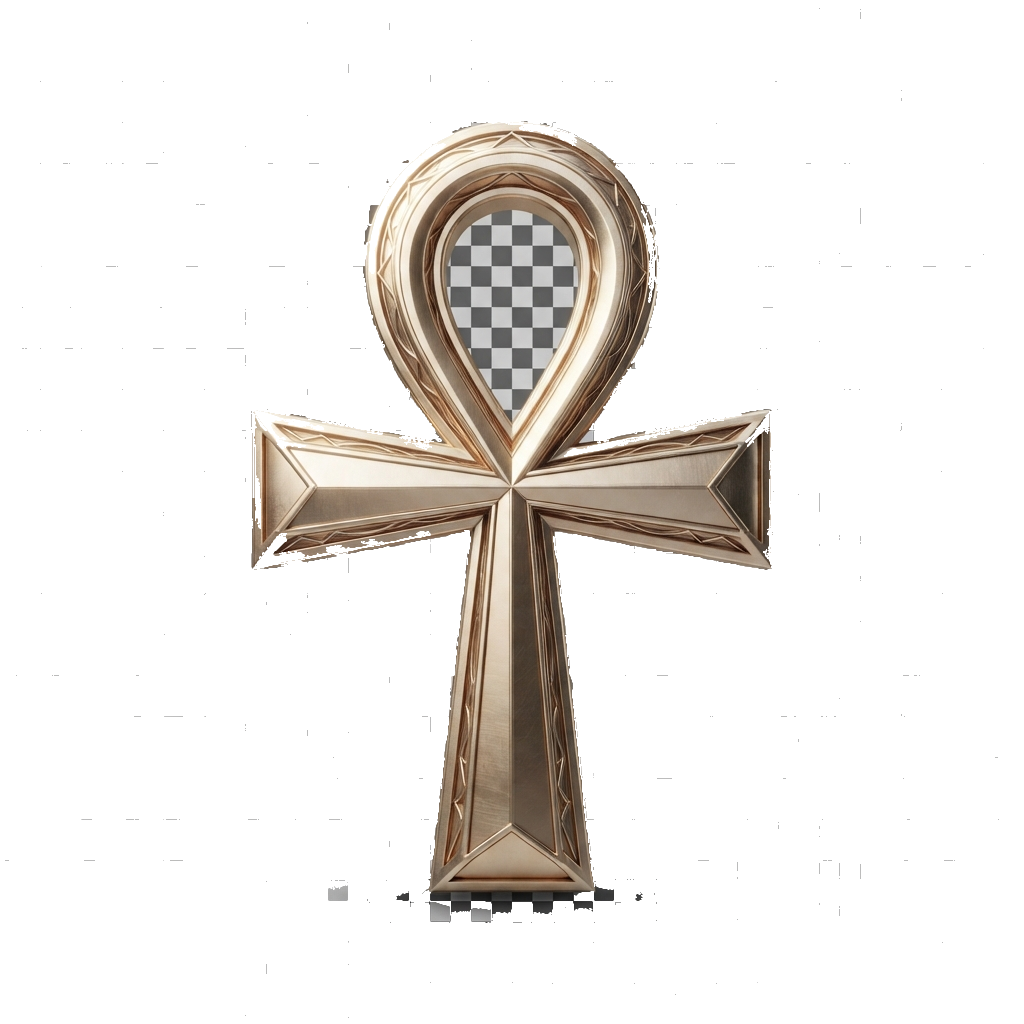
The Ankh is one of the most recognizable symbols of Ancient Egypt. Its shape consists of an oval loop placed atop a vertical cross, a simple yet instantly identifiable structure. In Egyptian iconography,
the Ankh rarely appears alone: it is often depicted in the hands of gods or offered to pharaohs. This staging highlights its active role in the transmission of life and in the relationship between deities, rulers, and human beings.
In hieroglyphic writing, the Ankh literally means “life.” It expresses vitality, duration, and the essential energy that sustains existence. In a single sign, the ancient Egyptians managed to represent a complex and fundamental concept. This capacity for synthesis explains the symbolic power of the Ankh in Egyptian culture.
The Ankh is also known by the modern term “cross of life.” This name reflects its symbolic function: it represents not just birth, but a complete, protected, and lasting life. Over time, this deeply religious symbol transcended the framework of worship to become a universal cultural symbol, associated with life, protection, and the continuity of existence.

Origins and possible interpretations of the Ankh

The Ankh in the hands of the gods: the gift of life

Ankh, royalty, and maintaining order

The funerary role of the Ankh: eternal life and rebirth
Ankh and fertility: a symbolic reading of life
In Ancient Egypt, the notion of life was closely linked to fertility. This idea concerned human beings as well as nature, agricultural lands, and the harvests that ensured the people’s subsistence.
In this context, the Ankh symbol fits into a global vision of existence where life must be continuously renewed. It represents the capacity to procreate, to nourish, and to maintain the balance necessary for the continuity of the world.
Fertility is perceived as a direct manifestation of life force. The Ankh embodies this fundamental energy that allows life to grow and perpetuate itself. It reminds us that existence can only endure through a constant cycle of birth, growth, and renewal. The symbol thus supports the idea of a natural order where vitality circulates between beings, the earth, and divine forces.
In a civilization deeply tied to agriculture, these notions are essential. Prosperity depends on natural cycles and the fertility of the land. The Ankh then becomes a sign of abundance and harmony, evoking a life that develops in a balanced way. It is also part of the imagery linked to the Nile, whose regular flooding brought fertility and renewal to Egyptian lands.

The Ankh as an amulet: protection and daily use
Beyond temples and religious depictions, the Ankh gradually became a personal object carried by individuals. In the form of an amulet, it was used in daily life to carry a symbol of life, protection, and stability. Its use was not limited to pharaohs or priests: over time, it spread widely throughout Egyptian society.
This popularity shows the importance of the symbol in the culture of the time. The Ankh no longer concerned only religious or political elites, but addressed anyone seeking to protect themselves and preserve vitality in their life.
Wearing an Ankh amulet thus meant seeking the preservation of life and balance against negative forces or disorder. The symbol provides reassurance through its clear and universal meaning. It embodies the continuity, stability, and life force that sustains existence. This protective function largely explains its diffusion and longevity in Egyptian culture.
Over time, the Ankh also evolved into an aesthetic object. Its simple and harmonious shape adapts easily to the creation of jewelry. Even today, it is worn as a pendant or talisman, connecting the heritage of Ancient Egypt to a personal and contemporary expression.

FAQ about the Ankh symbol and its role
What is the Ankh symbol?
The Ankh is an ancient Egyptian symbol in the shape of a cross topped by a loop. It is a hieroglyph that represents the word “life,” and in Ancient Egypt, it symbolized earthly life, eternal life, and the vitality granted by the gods.
What does the Ankh mean in Egyptian culture?
The Ankh primarily means life, but can also represent immortality, regeneration, air, or water—elements essential to maintaining life—as well as the connection between material life and spiritual life.
Why do the gods hold the Ankh in depictions?
In Egyptian art, gods are often depicted holding the Ankh to show that they have the power to grant life, protection, and blessings to pharaohs or the deceased in the afterlife.
Does the Ankh represent eternal life?
Yes. In Egyptian thought, the Ankh symbolizes not only life on earth but also the continuity of life after death and the immortality of the soul in the afterlife.
What does the shape of the Ankh represent?
The shape of the Ankh—a loop above a cross—symbolizes the union of the material world and the spiritual world, or the junction between earthly life and eternal life. This shape has also been interpreted as a sign of fertility or creation.
Why is the Ankh called the key of life?
It is sometimes called the key of life because it is believed to represent access to existence, the afterlife, and the mysteries of creation, suggesting a link between this world and the beyond.
What is the historical origin of the Ankh?
The Ankh symbol dates back to Ancient Egypt as early as the First Dynasty around 3150 BC, and it frequently appeared in art, hieroglyphs, and ritual objects as a central emblem of life and existence.
Is the Ankh associated with other beliefs or religions?
Yes. After antiquity, the Ankh influenced other symbols, such as certain forms of Christian crosses in Egypt, and today it is also used in various spiritual or cultural traditions to represent life, protection, or cultural identity.
Why do some people wear an Ankh pendant today?
Nowadays, the Ankh is often worn as jewelry or a talisman symbolizing life, protection, balance, or spiritual identity, or simply to honor the culture and heritage of Ancient Egypt.
Can the Ankh represent something other than life?
Yes. Beyond life, the Ankh can also symbolize fertility, creation, rebirth, the union of opposites, as well as the interconnection between spirit and matter in the universe.


