

With over 14 years dedicated to Egyptian-inspired jewelry, he has personally examined thousands of scarab, ankh, and Eye of Horus pieces.
Egyptian Cat: Bastet and Home Protection
A discreet yet essential presence in daily Egyptian life, the egyptian cat quickly gained spiritual significance. Its presence brought comfort, organized the household, and punctuated domestic rituals. Even before being considered sacred, it was already seen as a protective and beneficial companion.
Origin and Mythology
The cat was one of the most sacred animals in Egypt, intimately linked to the goddess Bastet, daughter of the sun god Ra. Bastet, described as the protector of the home, fertility, and women, was also associated with the Eye of Ra. Initially depicted as a lioness, she gradually took on the appearance of a cat, a symbol of gentleness and protection. The domestic cat was thus viewed as a living manifestation of Bastet, to the extent that families would mourn its death, shave their eyebrows, and organize funerals with mummification. Its veneration expressed the Egyptian respect for motherhood, domestic joy, and feminine protection.
Meaning and Legacy
Wearing or displaying a cat symbol means invoking the protection of Bastet and evoking the warmth of the home, fertility, and feminine grace. In modern jewelry, cat-shaped pendants or Bastet head charms are talismans believed to ward off negative energies. The cat also recalls its role as a defender of the home: the Egyptians attributed to it the ability to hunt snakes and rodents, symbols of chaos. Even today, the image of the egyptian cat evokes the harmony between strength and gentleness.

Snake: Royal Cobra and Uraeus
The snake holds a central place in Egyptian thought, being both feared and deeply respected. Its behavior, posture, and speed made it a natural symbol of vigilance. It is this ambivalence that elevated it to the rank of a royal emblem.
Origin and Mythology
The snake, especially in the form of the reared cobra known as the uraeus, is omnipresent in pharaonic art and represents the goddess Wadjet, the incarnation of the Eye of Ra. This protective cobra, described by the V10 hieroglyph, symbolizes the divine power of the pharaoh and appears on his crown to defend the sovereign against his enemies. As the “son of the sun,” it distinguishes kings from mere mortals and strengthens their bond with the gods. The snake is also associated with the goddess Wadjet, protector of the Nile Delta, who spits fire to repel threats. Present on diadems, scepters, and funerary pectorals, the cobra recalls its role as a guardian and symbol of rebirth.
Meaning and Legacy
In jewelry, the image of the snake symbolizes royalty, protection, and vital energy. The Egyptians saw the reptile as an ambivalent symbol: dangerous and healing, destructive and regenerative. Wearing a snake-shaped pendant evokes wisdom and the ability to defend oneself. Today, this motif remains popular in Egypt-inspired jewelry, particularly on protective Eye of Horus necklaces and snake bracelets that recall the majestic uraeus.
Cleopatra: Queen and Symbol of Femininity
Cleopatra belongs to the rare figures whose history has fueled legend. Her reign, marked by the art of governance and diplomatic skill, still fascinates today. Her complex personality makes her a unique character in the Egyptian pantheon.
Origin and Myth
Cleopatra, the last queen of the Ptolemaic dynasty, has become a true historical icon. Sources show that it was not just her beauty, but above all her wit, charisma, and political intelligence that seduced her allies. Her voice, grace, and mastery of many languages made her presence unique. She spoke directly to many peoples without an interpreter, unlike many sovereigns before her. Today, she is perceived as a figure of female power, blending politics, seduction, and pharaonic heritage to defend Egypt’s independence against Rome.
Meaning and Legacy
While Cleopatra is not a hieroglyphic symbol, she symbolizes female strength and autonomy. In jewelry, her profile is often associated with snake necklaces or pendants to recall the queen’s dual image: sensual yet strategic. In modern language, Cleopatra has become synonymous with a powerful, seductive, and cultured woman.
Anubis: The Jackal of the Necropolis
A god closely linked to the funerary world, Anubis is one of the most recognizable deities of Egypt. His role goes beyond simple protection: he embodies the mastery of the passage between two worlds. His image invites us to understand the Egyptians’ relationship with death and justice.
Origin and Mythology
Anubis, depicted as a man with the head of a dog or a jackal, is the illegitimate son of Osiris and Nephthys according to the Ministry of Culture. He participated in the creation of the first mummy by helping Isis and Nephthys embalm Osiris. As the protector of the necropolis, he is nicknamed the “guardian of the embalmers” and guides souls to the afterlife. In the scene of the weighing of the heart, Anubis compares the heart of the deceased to the feather of Maat to determine their access to the afterlife. This role makes him a moral arbiter, the guarantor of divine justice.
Meaning and Legacy
Anubis symbolizes the transition to the afterlife, protection against malevolent forces, and respect for funerary rites. Amulets representing Anubis were worn to ensure good protection after death. Today, jackal-head pendants recall his role as a guardian and psychopomp. Choosing jewelry with his image means invoking protection during difficult transitions, honoring the memory of the deceased, and remembering the importance of justice.

Pharaoh: Divine Sovereign and Attributes
The pharaoh was not just a ruler: he was the center of earthly and celestial balance. Every aspect of his appearance and gestures referred to a sacred function. Understanding the pharaoh means touching the heart of Egyptian civilization.
Origin and Symbolism
The pharaoh is the king of Egypt, considered the living incarnation of Horus and the son of the sun god Ra. His role goes beyond politics: he is a religious leader, military commander, and guarantor of cosmic order. His sacred attributes—crowns, the nemes headdress, the blue khepresh crown, the heqa scepter, and the nekhekh flail—symbolize his authority, while the uraeus protects his royalty. The false beard and bull’s tail express his wisdom, fertility, and virile power. Together, these insignias remind us that the pharaoh is both the protector of the people and the holder of divine power.
Meaning and Legacy
Today, images of pharaohs adorned with their regalia evoke absolute power, stability, and protection. Jewelry featuring pharaohs or bearing royal motifs (cross, scepter, uraeus) is synonymous with authority and charisma. Wearing a pharaoh pendant means asserting one’s inner leadership and connection to the millennial history of Egypt.

Cartouche: The Sacred Oval that Protects the Name
The cartouche materializes the importance of the name in Egyptian thought. To frame a name is to give it a protected, almost immortal existence. This symbol reflects the deep bond between identity and spiritual protection.
Origin and Usage
The cartouche (V10 hieroglyph) appears as an oval rope closed by a knot. It symbolizes everything the sun surrounds—that is, the universe—and its function is to protect the pharaoh’s name. Cartouches were painted in yellow or gold and contained the two royal names: the Nesout-bit “King of Upper and Lower Egypt” and the Sa-Ra “Son of Ra.” This magical frame was intended to prevent evil forces from altering the sovereign’s identity.
Meaning and Legacy
In contemporary jewelry, a cartouche-shaped pendant engraved with a name serves as a personalized amulet. Encircling a name within the oval reinforces the protection and immortality of that identity. Wearing a cartouche means asserting one’s spiritual bond with the sun and the universe. It is also a nod to the pharaohs, whose names engraved in cartouches have spanned the centuries.
Talisman: Amulets and Daily Protection
The Egyptians placed great value on objects charged with intention and power. A talisman accompanied every stage of life, always chosen for its specific function. These small objects were a concrete way to interact with invisible forces.
Origin and Mythology
The Egyptians used numerous amulets for protection in life and in death. Everyone wore these talismans made of precious stone or faience to guard against illness and danger. Among the most well-known, the ankh represented life and the vital breath. The scarab, a symbol of rebirth, was often placed on mummies to protect the heart of the deceased against malevolent spirits.
Meaning and Legacy
Today, the term “talisman” refers to any symbolically charged object. In the Egyptian view, an amulet is not just jewelry: it is a mediator between the wearer and the divine world. A necklace adorned with an ankh or a scarab is therefore not merely decorative: it transmits the protection, luck, and regenerative energy of ancient Egypt. Modern amulets perpetuate this tradition by inviting a spiritual connection.
Scarab: The Solar Insect and Rebirth
The scarab represents one of the most beautiful metaphors of nature observed by the Egyptians. Its ability to transform its environment fueled a powerful imagination around regeneration. This insect became much more than a simple animal: it became a cosmic message.
Origin and Mythology
The scarab (kheper) is one of the most famous symbols of ancient Egypt. The Egyptians saw in the dung beetle, rolling its ball of dung, an image of the god Khepri pushing the sun across the sky. It thus became a symbol of rebirth, regeneration, and the immutable cosmic cycle. Scarabs were carved in stone or molded in faience and worn as protective amulets. The heart scarab, placed on the chest of mummies, served to protect the heart of the deceased during the weighing of the soul.
Meaning and Legacy
The scarab symbolizes rebirth, transformation, and solar protection. Jewelry adorned with scarabs evokes a new beginning, hope, and the continuation of life after death. Wearing a silver or gold scarab pendant is a way to assert one’s resilience and remind oneself that every end is a beginning. It is also a tribute to Khepri, god of the sunrise.

Eye of Horus: The Oudjat Eye, Symbol of Healing
The Eye of Horus immediately evokes notions of vigilance and inner balance. Its expressive form tells a story of loss and restoration. This symbol is used wherever clarity and stability are sought.
Origin and Mythology
The Eye of Horus (oudjat), the “preserved eye,” represents the eye of the falcon Horus, torn out by Seth and then restored by Thoth, making it a symbol of healing and resurrection. After recovering his eye, Horus offered it to Osiris to restore his life, reinforcing its association with protection. The eye is also linked to the moon and sacred fractions, with each part representing a fraction that symbolizes regained unity. Used on amulets, sarcophagi, pectorals, and even on boats, it served to protect against illness, danger, and accidents.
Meaning and Legacy
The Eye of Horus symbolizes protection, health, clear vision, and healing. In jewelry, it is often combined with the ankh or the scarab to reinforce protection. Wearing an Eye of Horus pendant allows one to invoke clairvoyance and reconstruction after an ordeal. It is also a reminder of the mind’s ability to regenerate and regain its integrity.

Ankh: The Key of Eternal Life
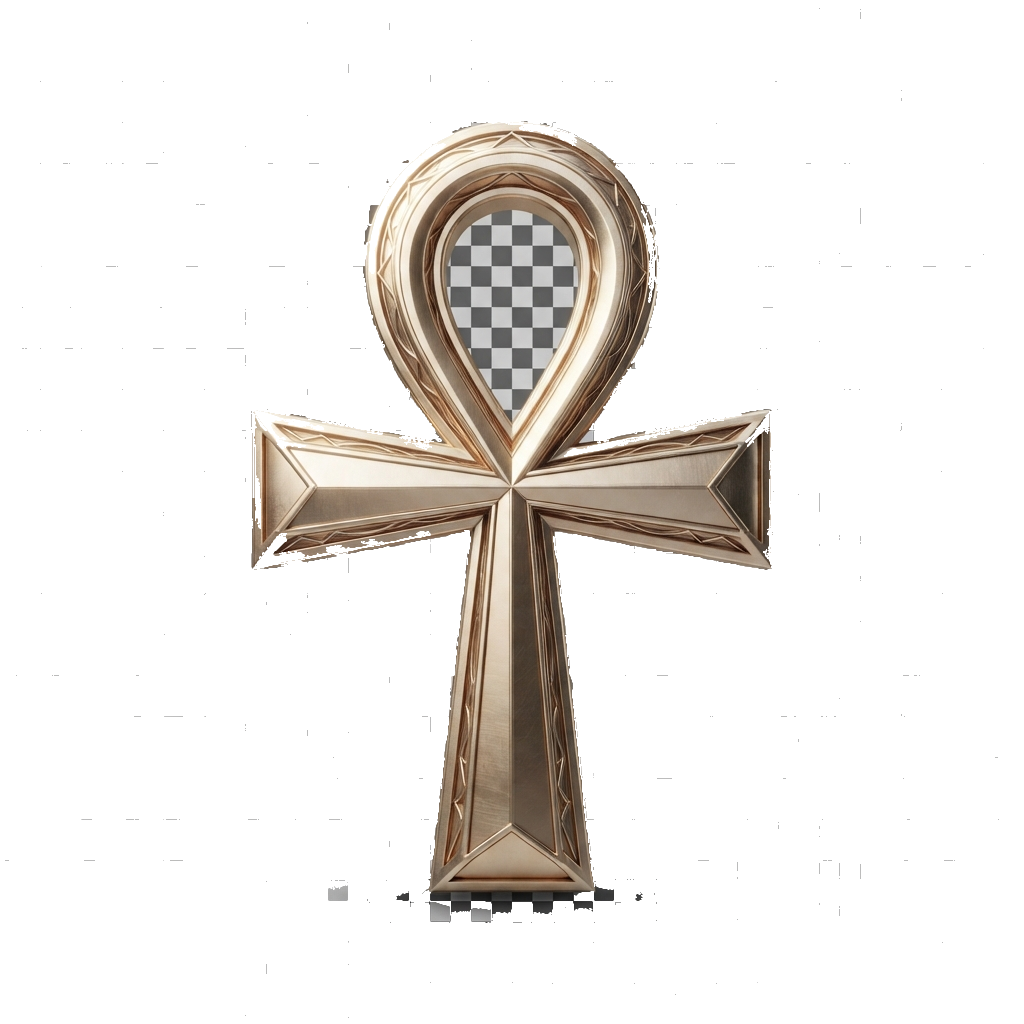
The ankh catches the eye with its simple yet deeply evocative silhouette. It summarizes an optimistic vision of existence: that of an energy that circulates and renews itself. Its symbolic power has allowed it to span the millennia.
Origin and Mythology
The ankh, called the key of life or key of the Nile, is one of the most famous symbols of ancient Egypt, representing vitality and eternity. It is often interpreted as the union of the masculine principle (vertical bar) and feminine principle (upper loop), the source of the Nile’s flooding and fertility. On bas-reliefs, the gods hold the ankh toward the noses of kings to transmit the vital breath to them. Used as an amulet, the ankh protected the living and was placed on mummies to ensure eternal life.
Meaning and Legacy
The ankh symbolizes life, immortality, and the balance between masculine and feminine forces. In modern jewelry, ankh pendants embody the energy of life and are often given as good luck charms. Wearing them can signify the search for spiritual balance and a connection with pharaonic history. The ankh remains a timeless motif that transcends trends.
Why Wear These Symbols?
Egyptian symbols are not mere decorations; they constitute a codified language that connects the human being to the divine, nature, and the community. Each of the ten symbols presented—from the protective cat to the royal snake, from Cleopatra to Anubis, from the divine pharaoh to the protective cartouche, from the talisman to the ankh—conveys a story and a profound meaning of Egyptian symbols. Wearing them today, whether as a necklace, ring, or tattoo, means claiming a fragment of this ancient wisdom.


