

With over 14 years dedicated to Egyptian-inspired jewelry, he has personally examined thousands of scarab, ankh, and Eye of Horus pieces.
History and origins of the Egyptian Ankh
Before grasping the full symbolic power of this sacred sign, we must return to its roots. The Egyptian Ankh traces its origins back to the earliest civilizations of the Nile, long before it became a universal spiritual emblem. Its design, both simple and enigmatic, has fueled numerous theories regarding its meaning and role in Egyptian culture. Between religious heritage, the representation of the vital breath, and cosmic mystery, the history of the Ankh remains one of the most fascinating of antiquity.
An ancient hieroglyph
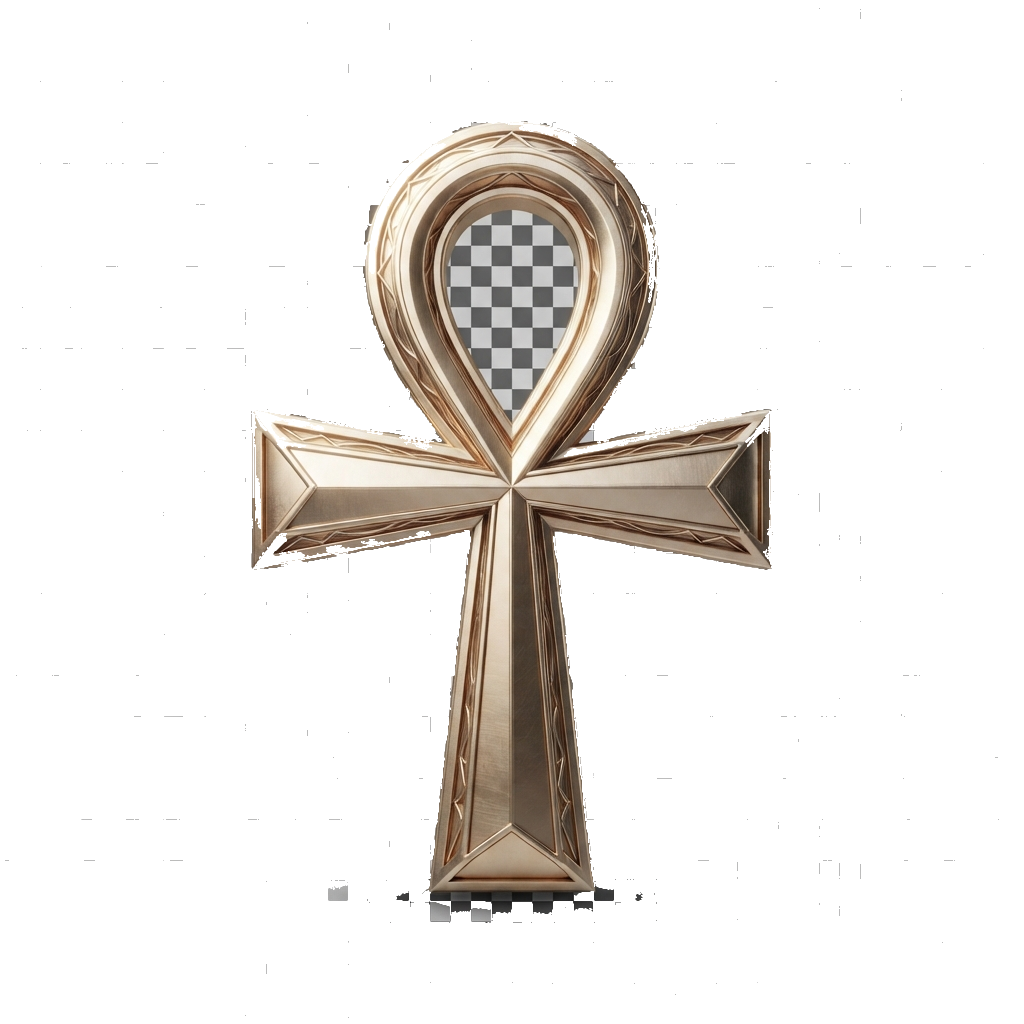
The Egyptian Ankh emerged at the beginning of the Dynastic period (circa 3150 BC). It consists of a vertical bar supported by a shorter horizontal bar and an oval loop at their intersection. This design resembles a Latin cross with the upper part replaced by a loop. In hieroglyphics, this sign represented life or the “vital breath,” and it has been interpreted as a key opening the gates to the afterlife, hence its nicknames “key of life” or “key of the Nile.”
Obscure origins and multiple interpretations
The Egyptians used the Ankh to symbolize life, but its exact origins are difficult to determine. Various theories have been proposed:
-
Union of masculine and feminine: the upper loop represents the womb or uterus, the vertical bar symbolizes the masculine principle, and the horizontal bar their union which creates life. The Ankh thus expresses fertility and the harmony of polarities.
-
Representation of the Nile: some interpretations see the vertical bar as the Nile Valley (Upper Egypt), the horizontal bar as the knot of Isis connecting the two banks, and the loop as the river’s mouth (Lower Egypt). The Ankh thus becomes the “key of the Nile,” an expression of the valley’s fertility.
-
Symbol of the sun and the horizon: according to another theory, the ring represents the sun rising above the horizon (the horizontal bar), symbolizing daily rebirth and eternity.
-
According to Egyptologist Alan Gardiner, the Ankh originated from a sandal strap (nkh), while Wallis Budge associated it with the knot of Isis, a symbol of femininity and fertility. These theories show how the meaning of the Ankh has evolved over the centuries.

Appearance in art and rituals
In Egyptian art, the looped cross appears in tombs, on temple walls, stelae, statues, and friezes. Gods often hold it by the loop or the bar, sometimes in both hands crossed over the chest, and they present it to the mouths of the deceased to breathe in the breath of eternal life. Pharaohs wore it as an attribute of their divine nature. The Ankh served as a protective talisman and was frequently carved on sarcophagi. It was also placed in sarcophagi to ensure life after death and could represent water, air, or the sun, elements essential for survival.
Spiritual and symbolic meanings
Mystical and timeless, the Egyptian Ankh goes beyond the simple religious framework to embody a true philosophy of existence. Behind its clean lines lies a vision of the world where every being participates in the infinite cycle of life, death, and rebirth. Understanding the spiritual and symbolic meanings of the Ankh means diving into the heart of Egyptian thought, where life and eternity are one.
Life, immortality, and the eternal cycle
The Ankh symbolizes above all life and eternity. For the Egyptians, it represented the link between earthly life and the afterlife, a true “key of life” or “key of the Nile.” Placed near mummies to breathe life into them, it also evoked the cycle of the sun, a source of rebirth and immortality.

Union of opposites and fertility
The Egyptian Ankh symbolizes the union of opposing forces: masculine and feminine, earth and sky, visible and invisible. The loop represents the feminine principle, the vertical branch the masculine, and their intersection the creation of life. A symbol of fertility and harmony, the Ankh embodies the perfect balance between complementary energies.
Harmony and cosmic balance
The Ankh embodies the balance between the divine and the earthly, life and death, order and chaos. The loop symbolizes the eternal soul, while the vertical bar represents the physical world. This union of opposites makes the Ankh a symbol of harmony and rebirth, still used in modern spiritual practices.
Key of the Nile and abundance
Another interpretation describes the Ankh as the key of the Nile. The loop represents the fertile delta, while the vertical branch symbolizes the river that flows through Egypt. This vision highlights the importance of the Nile as a source of life and prosperity for the ancient Egyptians. The Ankh reminded people that abundance and fertility depend on the balance between natural forces, reinforcing the idea of cosmic harmony.
Role in Egyptian religion and culture
Present in temples, tombs, and sacred rituals, the Egyptian Ankh held an essential place in pharaonic religion. Much more than a simple symbol, it represented the direct link between gods and men, the divine breath that animated all things. Worn by pharaohs and used by priests, it was used to invoke protection, healing, and rebirth. Through it, the Egyptians expressed their faith in an eternal life, guided by the power of the gods and the balance of the cosmos.
Divine gift and royal legitimacy
In Egyptian art, the gods often extend the Ankh to pharaohs to grant them protection and divine energy. This sacred gesture, performed by Ra, Isis, or Osiris, symbolized the transmission of the vital breath from the gods to men. It reinforced royal legitimacy by affirming the sovereign’s divine power.
The Ankh and the vital breath
The Pyramid Texts present the Ankh as a key opening the gates of heaven. Placed near the lips of the deceased, it restored their vital breath to access eternity. The gods are also depicted purifying the king with a flow of Ankhs, a symbol of regeneration and spiritual rebirth.

Amulets, healing, and protection
The Ankh served as a protective amulet, crafted from gold, faience, or wood to attract vitality and fertility. Placed on the deceased, it favored their rebirth in the afterlife and protected the living from illness. Priests also used it during purification rites to cleanse the body and soul with sacred water.
Connection with gods and myths
Many Egyptian deities are associated with the Ankh. Isis, Maat, Atum, or Sekhmet are frequently depicted holding the Ankh. In the mythology of Osiris, the Ankh symbolizes the resurrection of Osiris thanks to Isis, making this symbol a sign of rebirth. The Ankh is also associated with medical texts, as some incantations combine the Ankh with healing rites.
Spread into other cultures
The Egyptian Ankh quickly crossed the borders of Ancient Egypt. Adopted and transformed by other cultures, it retained its meaning of life and eternity. Having become a universal spiritual symbol, the Ankh continues to connect the sacred and the human throughout the ages.

The Copts and Christian adoption
The Copts of Egypt adopted a version of the Ankh called the crux ansata, or “handled cross.” Inspired by crosses carved in ancient temples, it was associated with the Christian faith and became the emblem of Coptic Christianity. This symbol of eternity, close to the cross of Christ, deeply influenced religious iconography.
Syncretism and later religions
Over the centuries, the Ankh has taken on new meanings according to different cultures: a symbol of immortality, fertility, or divine protection. In esotericism, it embodies the union between the material and spiritual worlds, the balance between life and death. Even today, this cross inspires meditations, rituals, and talismans carrying vital energy.
The Ankh in the contemporary world
An ancestral symbol reinvented, the Egyptian Ankh today occupies a place of choice in modern culture. From jewelry designers to contemporary artists, it embodies both the spirituality and the timeless aesthetic of Ancient Egypt. Worn for its elegance or its symbolism, the Ankh continues to unite sacred heritage and personal expression.
Jewelry and fashion
In current fashion, the Egyptian Ankh has become a symbol that is both spiritual and aesthetic. Appreciated for its timeless appeal, it is available as pendants, rings, or earrings in gold, silver, or stainless steel. Worn as a talisman or a style accessory, the Ankh elegantly connects ancient heritage and modern expression.
Discover our Egyptian Ankh ring in stainless steel and wear, every day, the eternal symbol of life and divine protection.

Spirituality, art, and tattoos
The Egyptian Ankh also stands out as a powerful spiritual symbol in art and tattooing. It inspires those who seek to express the balance between body and mind, between life and eternity. Whether engraved on the skin, painted on a canvas, or worn as jewelry, the Ankh connects artistic creation to inner quest and universal spirituality.
Choosing an Ankh piece: practical tips
If you wish to offer or wear jewelry highlighting the Egyptian Ankh, here are some tips to guide your customers:
-
Material and quality: prioritize noble materials like gold, silver, or stainless steel to ensure durability. The spiritual meaning of the Ankh pairs well with the beauty of precious metals.
-
Size and design: the Ankh exists in minimalist versions or adorned with patterns. Simple models emphasize the symbolism, while decorated versions (with stones or hieroglyphic motifs) add a luxurious touch.
-
Authenticity: for history enthusiasts, choose models inspired by Egyptian representations (pronounced oval loop, short horizontal arms). Some artisans offer more contemporary versions, which may appeal to a modern clientele.
-
Personal use: encourage customers to wear the Ankh as a pendant near the heart or to place it on a spiritual altar for meditation. The cross can also be given as a gift to symbolize eternal life, protection, or a rebirth.

FAQ about the Egyptian Ankh
What is the Ankh?
The Ankh is an Egyptian hieroglyph in the shape of a cross topped with a loop. It represents the word “life” and symbolizes the union of earthly life and the afterlife. It is also nicknamed the key of life or the Egyptian Ankh.
What is the meaning of the Egyptian Ankh?
The Ankh embodies eternal life, fertility, and the balance between opposing forces. Its ring represents the feminine principle or the sun, while the vertical bar symbolizes the masculine principle. Together, they evoke the cycle of life, death, and rebirth.
Is the Ankh linked to Egyptian gods?
Yes. Many deities, such as Isis, Osiris, Maat, and Sekhmet, hold the Ankh in Egyptian art. The gods sometimes present it to pharaohs to transmit the breath of life and ensure their legitimacy.
Why wear jewelry representing the Ankh?
Wearing an Egyptian Ankh can symbolize a connection to life, harmony, and protection. In ancient beliefs, the Ankh served as an amulet to ensure health, prosperity, and rebirth. Today, it is also an aesthetic symbol that evokes history and spirituality.
What is the difference between the Ankh and the Christian cross?
The Christian cross is a Latin cross, while the Ankh is distinguished by its upper loop. Inspired by the Ankh, the Coptic crux ansata blends Egyptian symbolism and Christian faith. One evokes redemption, the other eternal life and cosmic harmony.
Where does the word Ankh come from?
The Egyptian word nḫ means “life” or “vital breath.” Variants like anokh and anokhy are found in the Coptic language and biblical Hebrew. The Ankh is therefore associated with life and eternity in several traditions.
Is the Ankh a lucky charm?
In Ancient Egypt, the Ankh was attributed with powers of protection, healing, and fertility. Amulets in the shape of an Ankh were used to ward off evil and attract health. Today, many people wear it as a lucky charm or a spiritual talisman.
Eternal legacy of the Egyptian Ankh
The Egyptian Ankh is much more than a simple decorative motif: it condenses thousands of years of symbolism, beliefs, and spiritual practices. As a hieroglyph meaning “life,” it represents the harmony between body and mind, masculine and feminine, earth and sky. On temple walls or around the neck, the Ankh continues to fascinate and protect.


